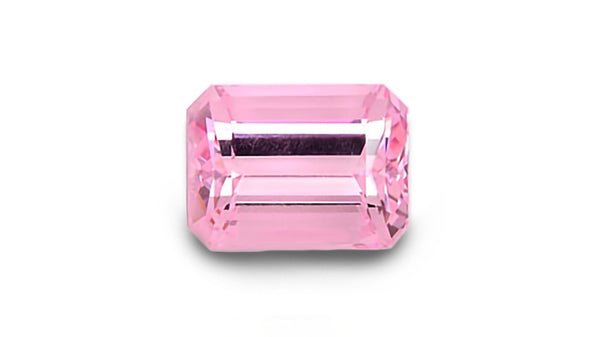
Kunzite: Why It Fades, Why It's Irradiated, What It Costs
The pink crystal in a kunzite pendant and the lithium in the battery of the device you are reading this on come from the same mineral, and often from the same hole in the ground. Kunzite is spodumene, and spodumene is one of the world's principal lithium ores.
Nobody digs for kunzite. Kunzite is what turns up while somebody is digging for something else, and almost everything a buyer needs to know about the stone follows from that. It arrives in large clean crystals because lithium pegmatites grow large clean crystals. It is cheap at sizes that would be unthinkable in any other gem. It is a nightmare to cut. And its color, the soft pink that gives the stone its entire reason for existing, is the least permanent thing about it.
Nobody Digs for Kunzite
Spodumene is a lithium aluminium silicate, LiAl(SiO3)2, and it crystallizes in granitic pegmatites: the coarse, late-stage veins where a cooling magma's leftover fluids concentrate the elements that did not fit anywhere else. Lithium, beryllium, boron, caesium. Pegmatites are where nature keeps the odd items, and they are where beryl, tourmaline, and spodumene grow side by side.
Kunzite was first recognized in 1902 in the Pala district of San Diego County, California, in pegmatites being worked for tourmaline. Charles Baskerville named it the following year for George Frederick Kunz, the chief gemologist of Tiffany & Co., who described the material. The same Kunz would later attach J. P. Morgan's name to pink beryl, which is why we have morganite as well. Tiffany's naming department was busy in those years.
The commercially important deposits today are the pegmatite fields of Nuristan and Kunar in Afghanistan, which produce the strongest colors, along with Minas Gerais in Brazil, Madagascar, Pakistan, Nigeria, and the original Californian ground. All of them are lithium country. The gem's supply is governed by an industry that is not thinking about gems, and in an era of battery demand, that is a stranger position for a gemstone to occupy than it has ever been.
The Cut That Cutters Refuse
Spodumene is among the most difficult materials a lapidary can be handed, and experienced cutters routinely decline the work.
The problem is cleavage. Kunzite has perfect cleavage in two directions, meaning two separate planes running through the crystal along which the atomic bonds give way cleanly. It is also brittle. Hardness sits at 6.5 to 7, respectable enough against scratching, and hardness has nothing to do with any of this. A stone can be hard and still come apart in your hand, and the difference between hardness and toughness is worked through in our guide to gemstone hardness.
Layered on top of that is strong pleochroism. Kunzite shows different colors along different crystal axes, and the best pink lives looking down the length of the crystal, along the c-axis. A cutter therefore has to orient the stone for color, orient the table away from two cleavage planes, and hold on to enough weight to make the job worth doing. Skilled cutters set the cleavage planes diagonally to the table to reduce the risk. Every stage of faceting and polishing carries the possibility of losing the stone outright. Our article on the art of the gemstone cut covers why orientation is the decision that makes or breaks a gem.
This is also why kunzite is usually cut deep. A shallow kunzite goes pale and windowed. The depth is there to concentrate the color, and it is the reason a kunzite often looks smaller face-up than its carat weight suggests.
Manganese, and a Color on Loan
Pure spodumene is colorless. Kunzite's pink comes from traces of manganese in the crystal, held in color centers: sites where trapped electrical charges absorb light. The distinction matters. A chromium atom in a ruby is part of the crystal's furniture. A color center is a state, and states can be undone.
Light undoes them. This is the whole of kunzite's reputation, and it is worth stating without softening: kunzite fades. Prolonged strong sunlight, ultraviolet-rich display lighting, and heat all erase the color centers and drain the pink away. Some material fades in months. Some fades so slowly that a lifetime of ordinary wear leaves it looking much as it did. Nobody can tell you in advance which stone you are holding, and no visual inspection will tell you either. The trade has called kunzite the evening stone for a century, which is a gentler way of saying the same thing.
The same species produces a green gem, hiddenite, colored by chromium instead of manganese. What links every color in the family is that the crystal is a poor guardian of its own appearance. How trace elements and lattice defects produce the colors we see is covered in our guide to gemstone color.
Irradiation, and the Question Nobody Asks
Because nature supplies mostly pale kunzite and buyers want saturated kunzite, the market fills the gap in a reactor.
Irradiation, whether by cobalt-60 gamma source or electron beam, deepens the pink and violet by manipulating the same manganese-related color centers that daylight destroys. Gentle heating often follows, to shift the tone and improve stability. The process is widespread, it is applied to a great deal of Afghan, Pakistani, and Brazilian material, and it is entirely legitimate when it is declared. Irradiated stones are held until residual activity decays below regulatory limits before sale, and they are safe to wear.
The problem in this category has never been the treatment. The problem is the silence. Deeply colored kunzite offered at a price that seems too good is a signal, and it is a signal a great many sellers prefer their customers not to hear. Two further facts belong in any honest description. Irradiated color is often less stable than natural color, so the deepest pink can also be the fastest to leave. And a faded kunzite can be brought back: irradiate it again, which turns it green, then apply light or gentle heat to coax the green back to pink. A gemstone whose color can be reinstalled is a strange object to sell as permanent.
United States practice requires irradiated stones to be described plainly as irradiated. SOSNA Gems discloses every treatment on every stone, with the laboratory named, and where a report is silent on color origin we say that too. The general principles are set out in treated versus untreated gemstones, and which laboratory names actually mean something is covered in our overview of gemological laboratories.
Why Big Kunzite Is Cheap
In almost every gem species the price per carat climbs steeply with size, because large crystals are geologically improbable. Kunzite runs the other way, and the reason sits in the pegmatite. Lithium pegmatites grow spodumene crystals by the metre, and clean transparent material at fifty or a hundred carats is not an event. The Smithsonian holds a faceted kunzite of 880 carats, and a stone of that scale in ruby or emerald would be among the most famous objects on earth.
| Category (2026) | Indicative retail per carat |
|---|---|
| Pale pink, commercial quality, any size | $5 to $30 |
| Medium pink to lilac, well cut | $50 to $90 |
| Fine saturated pink-violet, Afghan (Kunar valley) | $100 to $200 and above |
| Very large clean stones, pale color | Often below $30; size adds little |
These are indicative figures observed in 2026, and any individual stone's value depends on its own quality and documentation. Saturation is what is being paid for here, and clarity is expected rather than rewarded, since kunzite is normally clean and an included stone is simply penalized. The practical consequence deserves stating plainly: in kunzite a small deeply colored stone can be worth more than a large pale one, which reverses the instinct most buyers bring with them.

A natural kunzite crystal. The prismatic, strongly striated habit is typical of pegmatite spodumene.

Kunzite, 880 carats, Smithsonian National Museum of Natural History. Sizes like this are the signature of a pegmatite gem.
A Gem With No Past
Kunzite was identified in 1902, and everything written about its ancient meaning was written after that date.
This is worth saying because the stone attracts more invented history than almost any other. Pink stones certainly carried associations in older cultures, and those stones were quartz, spinel, tourmaline, sapphire, beryl, or glass, because kunzite had not been recognized. There is no Egyptian kunzite, no Roman kunzite, no medieval kunzite. Modern crystal traditions do associate kunzite with the heart and with emotional calm, and those traditions are perfectly real as traditions. They date from the twentieth century, they are cultural rather than medical, and a stone should not be sold on a promise about how someone will feel.
What kunzite has instead is a commercial biography, which is a rarer thing than a folk one. It was found in a tourmaline mine, named by a chemist after a jeweler's gemologist, and marketed into existence by Tiffany & Co. It is one of the few gems that has been a product for its entire life.
Living With Kunzite
Kunzite belongs in pendants, earrings, and brooches, and it belongs in a ring only with a protective setting and an owner who understands the deal. Two cleavage planes and a brittle crystal mean a single sharp knock can end the stone.
- Clean with lukewarm water, mild soap, and a soft brush.
- Never use ultrasonic or steam cleaning, which exploit cleavage and thermal stress.
- Keep it away from a jeweler's torch, and tell any jeweler working on the piece that the stone is kunzite before they begin.
- Store it in the dark and keep it out of prolonged strong sunlight. This is the one instruction that actually preserves the stone's value.
Our general guide to gemstone care covers the rest, and our current stones sit in the kunzite collection.
Frequently Asked Questions
Does kunzite fade?
Yes. Kunzite's color comes from manganese-related color centers, which strong light, ultraviolet, and heat gradually destroy. Some stones fade in months and some hold their color for a lifetime of ordinary wear, and no visual inspection will tell you which one you have. The trade nickname, the evening stone, records the problem honestly. Store kunzite in the dark and keep it out of direct sun.
Is kunzite irradiated?
A great deal of it is. Gamma or electron-beam irradiation deepens the pink and violet by manipulating the same color centers daylight erases, and gentle heating often follows. The treatment is legitimate, the stones are safe to wear, and it must be disclosed. Deeply saturated kunzite offered cheaply is worth asking questions about.
What is kunzite made of?
Kunzite is the pink gem variety of spodumene, a lithium aluminium silicate that is also one of the world's main lithium ores. It grows in granitic pegmatites alongside tourmaline and beryl, and it is generally recovered as a by-product of lithium and tourmaline mining rather than sought for its own sake.
Why is large kunzite so affordable?
Because pegmatites produce large clean spodumene crystals routinely. In most gem species size is geologically improbable and the per-carat price climbs steeply; in kunzite it does not. A small, deeply saturated stone can be worth more than a large pale one.
Can kunzite be worn in a ring?
With care and a protective setting. Kunzite has perfect cleavage in two directions and is brittle, so a sharp knock can split it cleanly. A hardness of 6.5 to 7 protects it from scratches and offers no protection at all against impact. Pendants and earrings are the safer home.
What is the difference between kunzite and hiddenite?
Both are gem spodumene. Kunzite is pink to violet, colored by manganese. Hiddenite is green, colored by chromium. They are the same mineral species wearing different trace elements.
Does kunzite have ancient symbolic meaning?
No. Kunzite was first recognized in 1902 and named in 1903, so every claim of ancient tradition attached to it belongs to some other pink stone. Modern crystal traditions associate it with the heart and with emotional calm, and those traditions are twentieth-century in origin.
How can I tell if a kunzite has been treated?
Not by looking. Treatment detection in kunzite requires laboratory analysis, and even then a report may state that color origin is undetermined. The only reliable protection is a seller who names the laboratory, states the treatment, and admits it when the answer is unknown.