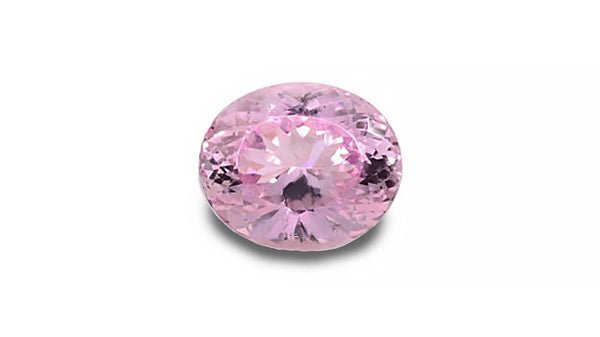
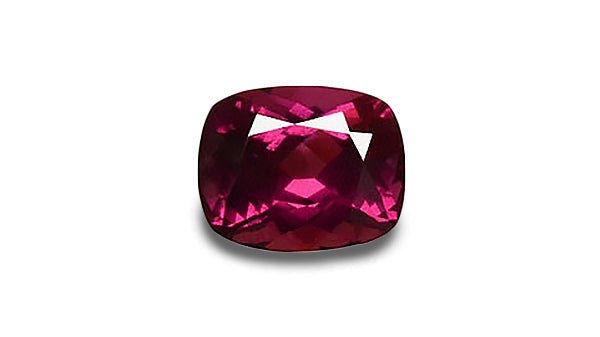
Imperial Topaz: Two Colors, One Crystal, and the Truth About Pink
Heat a fine golden-orange imperial topaz past roughly 450 °C and the gold burns away, leaving a pink stone behind. The pink was there the whole time. The trade has been doing this deliberately for well over a century, and a sunny window will perform a slower version of the same operation for free.
That single fact organizes everything worth knowing about imperial topaz. Its color is assembled from two ingredients with two different mechanisms and two very different life expectancies, and every stage of the stone's existence tests one of them: the rock it grows in, the cutter who orients it, the furnace it may or may not have passed through, the shop window it sits in, and the finger it ends up on. Imperial topaz is a lesson in what a color is actually made of.
Two Colors, Two Mechanisms
Topaz is aluminium fluorosilicate, Al2SiO4(F,OH)2, and in its pure state it is colorless. Every hue it displays comes from something added or something broken.
The pink and reddish component of imperial topaz comes from chromium substituting for aluminium in the crystal lattice, the same element that reddens ruby and greens emerald. This is a structural color. The chromium atom is part of the crystal, and short of destroying the stone, nothing will remove it.
The golden, orange, and brownish component comes from color centers: defects in the lattice where trapped electrical charges absorb light. These are not atoms. They are flaws, created by natural irradiation over geological time, and they can be undone. Warm the crystal past about 450 °C and the trapped charges are released, the defects heal, and the yellow-orange vanishes. What remains is the chromium pink underneath.
Two colors sharing one crystal, one of them permanent and one of them erasable. Everything else follows from this. Our guide to gemstone color covers how trace elements and lattice defects produce what the eye finally sees.
The Hill Above Ouro Preto
Almost every fine imperial topaz on earth comes from a single mining district around Ouro Preto in the Brazilian state of Minas Gerais, worked since the early eighteenth century. The Capão, Vermelhão, and Dom Bosco mines are the names that recur on dealer papers.
The geology is unusual and worth knowing, because it explains the near monopoly. Most topaz forms in granitic pegmatites, the coarse late-stage veins where large crystals grow slowly in fluorine-rich fluids. The Ouro Preto material instead formed in hydrothermally altered rhyolitic volcanic breccias, fractured rock through which fluorine-rich fluids circulated and deposited topaz alongside fluorite and cassiterite. That environment delivered chromium into the crystals in a way pegmatites elsewhere did not, and it is the reason this one district holds the color.
Annual production of gem rough from the district is measured in tens of kilograms, and the material rarely arrives large or clean. Why the ground a stone came from moves its price is the subject of our article on gemstone origins and rarity. Pakistan's Katlang deposit produces genuine natural pink topaz in small quantity, and the Russian Urals are historically important and effectively exhausted.
A Name With Two Fathers
Two stories compete for the word imperial, and the trade tells whichever one suits it.
The Brazilian version is specific and documented: in 1881 the French mineralogist Claude-Henri Gorceix, who founded the School of Mines at Ouro Preto that same year, presented one of the stones to Emperor Dom Pedro II and Empress Teresa Cristina. The Russian version holds that pink topaz from the Urals was named for the Tsar and reserved for the imperial family.
The Russian story deserves a closer look, because gem historians have found a hole in it. The only pink topaz deposit in Russia, on the Sanarka River in the southern Urals, was not discovered until 1853. That date has been used to challenge celebrated pieces of "Russian" pink topaz jewelry attributed to earlier decades, and it makes the romantic tale of Tsarist exclusivity harder to sustain than the retellings suggest. Neither version has been settled. What is settled is that GIA's early usage attached the word to Russian pink material, that it later transferred to Brazilian orange stones showing red dichroism, and that no official standard governs it today.
The practical consequence is that many dealers require a reddish flash visible along one crystal direction before they will call a stone imperial, and material in the plain golden-yellow range is sold as precious topaz or golden topaz instead. The word carries a premium, and no laboratory is obliged to grant it.
The Question Every Pink Topaz Has to Answer
The most repeated claim in the imperial topaz trade is that the stone is never treated. It is a claim this very article used to make in its older form, and correcting it is the reason the article was rewritten.
Heating Ouro Preto material to remove the yellow color centers and reveal the chromium pink beneath is a recognized commercial process, and it has been applied for a long time. The result is a stone whose pink is real, chemically identical to the pink of an untreated crystal, and arrived at through a furnace. It is a treatment, and it must be disclosed. Pink topaz is also produced from other material by irradiation followed by heating, which is a different process again and a different product.
Detection is genuinely difficult, which is precisely why the trade finds it comfortable to look away. Heat-treated stones may differ from untreated material in their ultraviolet fluorescence, and that criterion is still being refined. A report from a named laboratory is the only meaningful evidence, and even then a careful report may decline to reach a conclusion. The honest position, and the one SOSNA Gems takes, is to state what the report says and to say plainly when the report says nothing.
Anyone selling pink imperial topaz on the strength of the phrase "always untreated" is repeating a slogan rather than describing a market. What treatment does to a stone's identity, and why a laboratory's name matters more than the word certified, is covered in treated versus untreated gemstones and in our overview of gemological laboratories.
The same fragility has a second consequence, and here the old trade wisdom is right. Some sherry and brown topaz fades under prolonged strong light, because daylight is slowly doing what the furnace does quickly. Material known to fade trades at a discount among people who know. A window sill is a poor display case.
Hardness 8, and It Still Splits
Topaz is the reference mineral for 8 on the Mohs scale, harder than quartz and harder than emerald. It is also among the easiest fine gems to break, and the two statements sit together comfortably.
Hardness measures resistance to scratching. Toughness measures resistance to breaking, and they are separate properties. Topaz has perfect cleavage in one direction, a plane running across the crystal along which the atomic bonds are weak. A sharp knock delivered in the wrong direction will part a topaz cleanly along that plane, and hardness offers no protection whatsoever. A hard strike against a doorframe is enough.
This matters more than it sounds, because imperial topaz is routinely described as ideal for everyday wear on the strength of its hardness alone, which is careless advice. It is superb in pendants and earrings. In a ring it deserves a protective setting and an owner who takes it off before the gym. The distinction between hardness and toughness is worked through in our guide to gemstone hardness.
What the Cutter Has to Solve
A cutter facing imperial topaz rough has two constraints pulling against each other, and both pulling against yield.
Topaz is strongly pleochroic, showing different colors along different crystal directions, and the coveted reddish flash is usually visible along only one of them. Orient the stone to display that flash and weight may have to be sacrificed. Orient it for weight and the darker pleochroic color can pool at the ends of the finished gem, producing uneven color that a buyer notices immediately. On top of that, the table facet must be angled away from the cleavage plane, or the stone becomes a liability on the polishing wheel and later in the setting.
Rough of this quality is scarce, and cutters lose a great deal of it solving these problems. That is the practical reason large, evenly colored, eye-clean imperial topaz is rare, and the reason calibrated stones in standard jewelry sizes are harder to find than the price alone would suggest. Our article on the art of the gemstone cut covers why orientation decisions like these are among the most consequential a lapidary makes.
Rarity and Value in 2026
Imperial topaz is a collector's stone, priced far above the commercial topaz on jewelry counters and well below the classical big four. The ranges below are indicative retail figures observed in 2026, and any individual stone's value depends on its own quality and documentation, above all on the strength and evenness of the reddish component, on clarity, and on treatment status.
| Category (2026) | Indicative retail per carat |
|---|---|
| Golden to sherry, commercial quality | $50 to $250 |
| Fine imperial, 1 to 3 ct, clear reddish flash | $300 to $900 |
| Large vivid stones with strong pink-red overtone | $1,000 to $3,500 and above |
| Irradiated or coated topaz (blue, mystic) | $5 to $30 |
The last row is included deliberately. The gap between imperial topaz and the blue topaz sold by the ton is roughly a hundredfold, both are genuinely topaz, and the entire difference lies in which colors nature supplied and which ones a treatment plant did. That contrast is handled in our profile of the topaz family.
Almost Every Ancient Topaz Was Something Else
The lore attached to topaz is ancient, extensive, and mostly attached to the wrong mineral.
The name is generally traced to Topazios, the Greek name for a small island in the Red Sea now called Zabargad. The island never produced topaz. It produced peridot, and for most of recorded history the word topaz meant a golden or golden-green stone, applied to whatever fit. Egyptian and Roman associations with the sun, with Ra, with Jupiter, belong to gems a modern gemologist would identify as peridot or chrysoberyl or quartz. An alternative etymology traces the word to the Sanskrit tapas, fire, which suits the stone better than the island does.
The confusion ran in both directions and persisted into the modern era. Yellow citrine was sold as topaz for generations, and still is by the careless. When the first deep orange-red Brazilian stones reached Portugal in the eighteenth century they were marketed as Brazilian rubies, and they were set into ecclesiastical treasures under that name.
Where topaz does have a tradition of its own it belongs to the medieval and early modern period, when the stone was credited with steadying the mind and cooling the temper. It is the modern November birthstone under the list the American trade adopted in 1912, and the history of that list sits in our guide to birthstones. These are cultural traditions and they are worth telling as history rather than as properties.

The American Golden Topaz, 22,892 carats, Smithsonian Institution. The largest cut topaz in the world sits in the golden range and would not be classed as imperial, which is a useful measure of how narrow the imperial color window really is.
Living With an Imperial Topaz
Warm water, mild soap, a soft brush. Ultrasonic and steam cleaning are best avoided, because vibration and thermal shock both find cleavage planes. Store the stone away from harder gems, keep it out of prolonged strong sunlight, and set it so that a knock meets metal before it meets the gem. Our general guide to gemstone care covers the rest.
When buying, three things carry most of the weight: the presence and evenness of the reddish component, clarity, since imperial topaz is expected to be clean and inclusions are penalized here in a way they are forgiven in emerald, and a treatment statement from a named laboratory. Our current stones sit in the imperial topaz collection.
Frequently Asked Questions
What makes imperial topaz different from ordinary topaz?
Color and origin. Imperial topaz shows a golden-orange to reddish-pink range with a reddish flash visible along one crystal direction, and almost all of it comes from a single district around Ouro Preto in Brazil. Blue topaz, by contrast, is colorless topaz that has been irradiated and heated, and it is produced in effectively unlimited quantity.
Is imperial topaz always untreated?
No, and this is the most persistent myth in the category. Heating Ouro Preto material above roughly 450 °C removes the yellow color centers and leaves the chromium pink beneath, which is a recognized commercial treatment. Detection is difficult, so a report from a named laboratory is the only meaningful evidence of natural color, and an honest seller says so.
Why is imperial topaz pink or orange?
Two separate causes share the crystal. Chromium substituting for aluminium produces the pink and red. Color centers, which are lattice defects created by natural irradiation, produce the yellow and orange. The chromium is permanent. The color centers can be destroyed by heat or, more slowly, by strong light.
Does imperial topaz fade in sunlight?
Some material does, particularly in the sherry and brown range, because sunlight gradually erases the same color centers a furnace erases quickly. Stones with a known tendency to fade trade at a discount. Keep any topaz out of prolonged direct sun.
Is topaz durable enough for a ring?
With care. Topaz is hardness 8 and highly scratch resistant, and it has perfect cleavage in one direction, which means a sharp knock can split it cleanly. Hardness and toughness are different properties. A protective setting solves most of the problem.
Where does imperial topaz come from?
The overwhelming majority comes from the Ouro Preto district in Minas Gerais, Brazil, principally the Capão, Vermelhão, and Dom Bosco mines. Pakistan's Katlang deposit produces natural pink topaz in small quantity, and the Russian Urals are of historical importance and effectively exhausted.
Why is imperial topaz called imperial?
Two stories compete. In 1881 the mineralogist Claude-Henri Gorceix presented the stone to Brazil's Emperor Dom Pedro II, and the Brazilian trade dates the name from that event. A rival tradition credits the Russian court and pink topaz from the Urals, though the only Russian pink deposit was not found until 1853, which complicates several of the romantic claims made for it. No official standard governs the term today.
Is imperial topaz a good stone for a collection?
It has the characteristics collectors look for: a single dominant source, a narrow color window, difficult rough, and low yield. Value depends on the individual stone's color, clarity, size, and documentation rather than on the category name.