Morganite: The Gem of Love, Grace, and Elegance
Introduction
In December 1910, gemologist George Frederick Kunz stood before the New York Academy of Sciences and proposed a name for a newly discovered pink beryl from Madagascar: morganite, in honor of his most important client, the banker John Pierpont Morgan. Few gemstones owe their name so openly to a business relationship, and few have repaid the favor so well. A century later, the stone named as a courtesy to a collector has become one of the most requested center stones in modern bridal jewelry.
This guide explains what morganite is, why it is pink, what buyers should know about routine heating, where the finest material comes from, and how to judge color and quality in beryl's most romantic variety.
What Is Morganite?
Morganite is the pink-to-peach variety of beryl, the same beryllium aluminum silicate that produces emerald and aquamarine. It crystallizes in the hexagonal system, carries a refractive index of roughly 1.57 to 1.60, and rates 7.5 to 8 on the Mohs scale, placing it among the more durable colored stones. Like its siblings, it typically grows in granitic pegmatites, and like aquamarine it tends to form in clean, open pockets, which is why fine morganite is expected to be transparent and eye-clean.
One quirk separates it from its family: while aquamarine grows as long prisms, morganite usually forms short, tabular crystals, a habit cutters must work around when planning larger stones.
The beryl family at a glance:
| Variety | Color | Colored by | Rarity |
|---|---|---|---|
| Emerald | Green | Chromium, vanadium | Rare in fine quality |
| Aquamarine | Blue to blue-green | Iron | Widely available |
| Morganite | Pink to peach | Manganese | Uncommon |
| Heliodor | Yellow to golden | Iron | Uncommon |
| Goshenite | Colorless | None | Common |
| Red beryl | Raspberry red | Manganese | Extremely rare |
Our overview of the beryl family covers each variety in more detail.
Why Morganite Is Pink
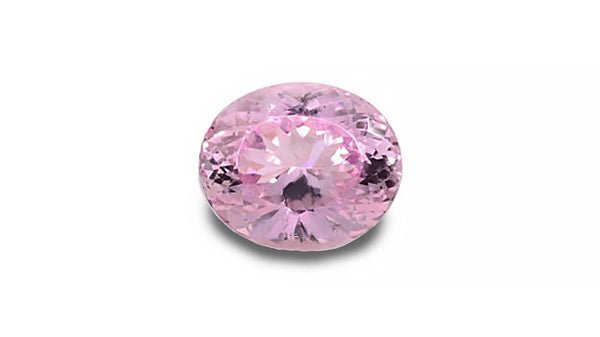
Pure beryl is colorless. Morganite's color comes from traces of manganese entering the crystal lattice, producing shades from pale blush through salmon and peach to deeper rose. The stone is also pleochroic: viewed down different crystal directions it shows slightly different tones, typically a paler pink and a deeper, faintly bluish pink. A skilled cutter orients the rough so the finished gem faces up with the richer of the two.
Treatment: What Buyers Should Assume
Much morganite comes out of the ground with a yellowish or orange cast alongside the pink. Gentle heating removes the yellow component and leaves a purer, more stable pink, and the treatment is routine, permanent, and undetectable, much like the standard heating of aquamarine. The market accepts it fully, but a seller should still say so.
The nuance worth knowing runs in the opposite direction. Untreated peach morganite, with its warm salmon tones intact, has developed a devoted collector following precisely because that color often signals a stone left as nature made it. What the classical grading treats as an impurity, a growing part of the market treats as provenance. The broader logic of treatment and value is covered in our guide to treated versus untreated gemstones.
Where Morganite Is Mined
Madagascar, where the naming discovery was made, still produces some of the finest pink and peach material. Brazil's Minas Gerais pegmatites supply much of the world's larger, cleaner rough, including intensely colored stones with high transparency. Afghanistan and Pakistan yield rare deeper pinks, Mozambique and Namibia contribute soft peach tones, and California's San Diego County pegmatites, an early source of pink beryl, retain historical importance.
Color and Value
Color drives morganite pricing, and the classical hierarchy is simple: the deeper and purer the pink, the higher the value, with saturated rose tones at the top and pale pastels below. Peach sits in a category of its own, priced by taste as much as by grade, and rare lavender-tinted stones attract collectors of the unusual.
Saturation in morganite depends heavily on size. The manganese coloring is subtle, so small stones often read almost colorless while the same material above five carats shows convincing pink. This is why morganite is one of the few gems where buying larger is a color decision, and why fine big stones carry a real premium over small ones beyond simple carat math.
Clarity, Cut and Size
Fine morganite is expected to be eye-clean, and most faceted material meets that standard. Ovals, cushions, and rounds dominate, with emerald cuts favored for stones with top color.
Beryl's talent for growing large applies here too. In October 1989, the Bennett Quarry in Buckfield, Maine, yielded a single gem morganite crystal weighing about 23 kilograms, promptly nicknamed the Rose of Maine. The Smithsonian Institution displays the other end of that story: a faceted Madagascan morganite of 598.7 carats, among the largest cut examples in the world.

The largest faceted morganite, 598.7 carats, from Madagascar, Smithsonian Institution.
Durability and Care
At 7.5 to 8 on the Mohs scale, morganite handles daily wear well, including engagement rings. Clean it with lukewarm water, mild soap, and a soft brush, keep it away from harsh chemicals, and avoid leaving it in strong sunlight for long periods, since extended exposure can soften the color. Store it apart from harder stones such as sapphire and diamond.
Morganite in Jewelry: The Engagement Ring Phenomenon
Morganite's rise over the past two decades has been driven by bridal jewelry. Its blush tones flatter nearly every skin tone, pair naturally with rose gold, and deliver the visual language of a pink diamond at a small fraction of the price. Paired with white metals it reads cooler and more formal; with yellow gold, warmer and vintage. For choosing a center stone with both eyes open, our engagement ring guide walks through the decisions step by step.
History and Symbolism
Beyond its banker's name, morganite carries a short but consistent symbolic record: a stone of gentle love, emotional balance, and devotion, associations that grew naturally from its color and its bridal role. These meanings belong to tradition rather than to any physical property of the stone, but they explain why morganite has settled so comfortably into jewelry that marks commitments.
Why Choose Morganite?
Morganite offers beryl pedigree, engagement-ready durability, reliable clarity, and a color that no other natural gem delivers at its price. It rewards buyers who understand its two honest trade-offs: color builds with size, and the purest pinks usually reflect routine heating while natural peach carries its own quiet prestige.
Choose the shade that suits the wearer, insist on knowing the treatment status, and morganite will do what it has done since 1910: make generosity look effortless.
Explore our selection of natural morganite gemstones, each described with full treatment disclosure.