Gemstone Density: The Specific Gravity Chart and Why It Matters
The Gemstone That Feels Wrong in the Hand
An experienced dealer can sometimes spot a fake before reaching for a single instrument. They pick the stone up, and it feels wrong: too light for its size, or unexpectedly heavy. What they are reading is density, and it is one of the most reliable properties in gemology, because unlike color it cannot be faked, and unlike clarity it cannot be improved.
Density explains why a one-carat sapphire looks smaller than a one-carat diamond, why glass imitations betray themselves on a scale, and why gemologists reach for a beaker of water when the microscope leaves doubt. This guide covers what it is, how it is measured, and how to use it.
What Is Specific Gravity?
Density is mass per unit of volume. In gemology it is expressed as specific gravity, abbreviated SG, which compares a gemstone's density to that of an equal volume of water.
The definition is simple: SG = weight of the gemstone ÷ weight of an equal volume of water. A stone with an SG of 4.00 is four times heavier than the same volume of water. The number has no units, which is why it works as a universal reference.
Every gem species has a characteristic SG range, and the ranges are narrow enough to be diagnostic:
- Amber: about 1.05, barely heavier than water
- Opal: 1.88 to 2.50
- Quartz: 2.65, one of the most constant values in gemology
- Emerald: 2.67 to 2.78
- Diamond: 3.50 to 3.53
- Corundum (ruby, sapphire): about 4.00
- Zircon: 3.93 to 4.73, the widest range of any common gem
- Cinnabar: up to 8.2, eight times the weight of water
Why Two One-Carat Stones Look Nothing Alike
This is where density leaves the laboratory and enters the jewelry case.
Carat is a measure of weight, not size. A denser mineral packs the same weight into less volume, so it faces up smaller. The consequences are immediate and visible:
- A one-carat sapphire is noticeably smaller than a one-carat diamond, because corundum at 4.00 is denser than diamond at 3.52.
- A one-carat emerald is larger than a one-carat diamond, because beryl is lighter.
- A one-carat opal is larger than both.
- A one-carat zircon is the smallest of the group, because zircon can reach 4.73.
The practical rule follows directly: compare colored gemstones by millimeter dimensions, never by carat weight alone. A jeweler quoting only carats is telling you half the story, and our guide to carats explained covers the rest of it.

How Gemologists Measure Density
Two methods dominate, and both are older than most of the equipment in a modern laboratory.
Hydrostatic Weighing
The classical method, and the one Archimedes would recognize. The stone is weighed in air, then weighed again suspended in water. The difference between the two weights equals the weight of the water it displaced, which gives its volume, which gives its density. The arithmetic is exactly the principle Archimedes is said to have discovered in his bath, applied to a gemstone instead of a crown.
It is accurate, non-destructive, and requires nothing more exotic than a good balance and a beaker. Its limitation is practical: it works on loose stones, and a gem already set in jewelry cannot be measured this way.
Heavy Liquids
The faster method, and the one that looks like magic to anyone watching. Gemologists keep a set of liquids of known density: bromoform at 2.89, methylene iodide at 3.32, and others. Drop a stone into a liquid and watch what it does. If it floats, it is less dense than the liquid. If it sinks, it is denser. If it hangs suspended, motionless, its density matches the liquid exactly.
Because quartz sits at 2.65 and most beryl below 2.78, a single liquid can sort a parcel of stones in seconds. The technique is quick, elegant, and requires chemicals handled with care, which is why it belongs in a laboratory rather than a kitchen.
Density as a Detective Tool
Density earns its reputation in identification, because it catches things the eye cannot.
Glass imitations. Most glass used to imitate gemstones has an SG between 2.3 and 4.5, and rarely matches the stone it copies. A "ruby" that weighs meaningfully less than corundum should is not a ruby.
Similar-looking species. Spinel and ruby can look nearly identical in color, and both come from the same Burmese marbles. Spinel sits at 3.54 to 3.63; ruby at 3.97 to 4.05. The difference is unmistakable on a balance, and it is one of the classical ways the two were finally separated. Our spinel guide tells the story of how long that confusion lasted.
Synthetics. Laboratory-grown stones usually match their natural counterparts in density, since the chemistry is identical, so SG alone will not separate them. It does, however, exclude simulants immediately, which is why it remains a first-line test. What separates a synthetic from a natural stone is growth structure, a subject covered in our guide to natural versus lab-grown gemstones.
Zircon's internal clock. One gem breaks the rule that species have stable density, and it does so in a way that reveals its history. Zircon contains traces of uranium, whose radioactive decay slowly disrupts the crystal structure over geological time, a process called metamictization. High zircon, with an intact structure, reaches 4.73. Low zircon, damaged by its own radioactivity, falls to 3.93. Measure a zircon's density and you have measured, roughly, how much time it has spent breaking itself apart.
Density rarely works alone. Paired with refractive index, it narrows almost any transparent gem to a single species, which is why a laboratory report states both values side by side near the top of the page.
What Density Does Not Tell You
Density is a physical property, not a quality grade. A dense stone is not a better stone, and a light one is not inferior. Opal, at the bottom of the scale, is prized precisely for what it is.
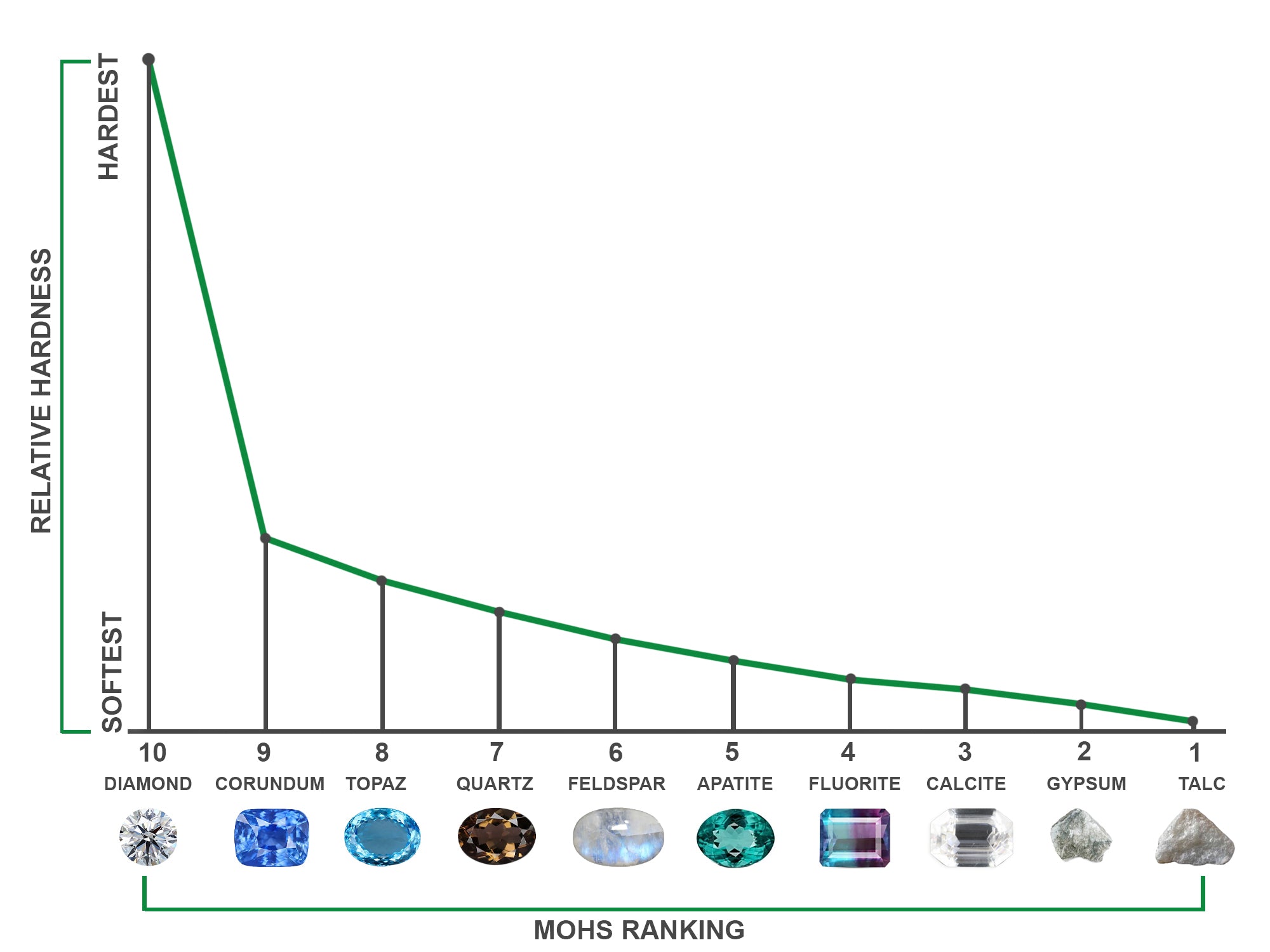
Nor does density say anything about hardness, and the two are routinely confused. Sphalerite is denser than diamond and sits in the same range as corundum, yet it rates only 3.5 on the Mohs scale, soft enough for a steel knife blade to mark it. Density measures how tightly matter is packed; hardness measures how well it resists being scratched. Our gemstone hardness guide covers the difference.
What density does give you is certainty, and in a market full of things that look like other things, certainty is valuable.
How SOSNA Gems Uses Density
Specific gravity is part of how we identify and verify the stones we sell. Where a stone's identity needs confirmation, or where a simulant is suspected, SG is measured by hydrostatic weighing before anything else is concluded.
Every gemstone we list carries its precise carat weight alongside exact millimeter dimensions, because weight without dimensions describes only half of what you are buying. Certified stones carry independent laboratory reports; the rest travel with the SOSNA Gems Colored Stone Report, stating identification, weight, measurements, color, clarity, cut, and treatment status. Our guide to reading a gem certificate explains what each line on such a document means.
Complete Density Table of Gemstones
The table below lists specific gravity and chemical composition for 145 gemstones, from cinnabar at the dense extreme to amber, which barely outweighs water. Stones we carry are linked to their collections.
| Gemstone | Name | Specific Gravity | Chemical Composition |
|---|---|---|---|
 |
Cinnabar | 8.0-8.2 | Mercury sulfide |
 |
Cassiterite | 6.7-7.1 | Tin oxide |
 |
Cerussite | 6.46-6.57 | Lead carbonate |
 |
Scheelite | 5.9-6.3 | Calcium tungstate |
 |
Cuprite | 5.85-6.15 | Copper oxide |
 |
Hematite | 5.12-5.28 | Iron oxide |
 |
Barite | 4.43-4.46 | Barium sulfate |
 |
Spessartine Garnet | 4.12-4.18 | Manganese aluminum silicate |
 |
Painite | 4.01 | Calcium aluminum zirconium borate |
 |
Smithsonite | 4.00-4.65 | Zinc carbonate |
 |
Ruby | 3.97-4.05 | Aluminum oxide |
 |
Star Ruby | 3.97-4.05 | Aluminum oxide |
 |
Celestine | 3.97-4.00 | Strontium sulfate |
 |
Sapphire | 3.95-4.03 | Aluminum oxide |
 |
Star Sapphire | 3.95-4.03 | Aluminum oxide |
 |
Zircon | 3.93-4.73 | Zirconium silicate |
 |
Almandine Garnet | 3.93-4.30 | Iron aluminum silicate |
 |
Sphalerite | 3.90-4.10 | Zinc sulfide |
 |
Rhodolite Garnet | 3.84 | Magnesium aluminum silicate |
 |
Color-Change Garnet | 3.78-3.85 | Complex aluminum silicate |
 |
Malaia Garnet | 3.78-3.85 | Complex aluminum silicate |
 |
Azurite | 3.77-3.89 | Basic copper carbonate |
 |
Demantoid Garnet | 3.70-4.10 | Calcium iron silicate |
 |
Alexandrite | 3.70-3.78 | Beryllium aluminum oxide |
 |
Alexandrite Cat's Eye | 3.70-3.78 | Beryllium aluminum oxide |
 |
Chrysoberyl | 3.70-3.78 | Beryllium aluminum oxide |
 |
Chrysoberyl Cat's Eye | 3.70-3.78 | Beryllium aluminum oxide |
 |
Vanadium Chrysoberyl | 3.70-3.78 | Beryllium aluminum oxide |
 |
Mali Garnet | 3.65 | Calcium aluminum silicate |
 |
Benitoite | 3.64-3.68 | Barium titanium silicate |
 |
Pyrope Garnet | 3.62-3.87 | Magnesium aluminum silicate |
 |
Taaffeite | 3.60-3.62 | Magnesium beryllium aluminum oxide |
 |
Grossular Garnet | 3.56-3.73 | Calcium aluminum silicate |
 |
Hessonite Garnet | 3.56-3.73 | Calcium aluminum silicate |
 |
Tsavorite Garnet | 3.56-3.73 | Calcium aluminum silicate |
 |
Spinel | 3.54-3.63 | Magnesium aluminum oxide |
 |
Kyanite | 3.53-3.70 | Aluminum silicate |
 |
Sphene (Titanite) | 3.52-3.54 | Calcium titanium silicate |
 |
Diamond | 3.50-3.53 | Carbon |
 |
Imperial Topaz | 3.49-3.57 | Aluminum fluosilicate |
 |
Topaz | 3.49-3.57 | Aluminum fluosilicate |
 |
Sinhalite | 3.46-3.50 | Magnesium aluminum borate |
 |
Rhodochrosite | 3.45-3.70 | Manganese carbonate |
 |
Serendibite | 3.42-3.52 | Complex borosilicate |
 |
Uvarovite Garnet | 3.41-3.52 | Calcium chromium silicate |
 |
Rhodonite | 3.40-3.74 | Manganese silicate |
 |
Tanzanite | 3.35 | Calcium aluminum silicate |
 |
Idocrase (Vesuvianite) | 3.32-3.47 | Aluminum calcium silicate |
 |
Epidote | 3.30-3.50 | Calcium aluminium iron sorosilicate |
 |
Hemimorphite | 3.30-3.50 | Hydrous basic zinc silicate |
 |
Diaspore | 3.30-3.39 | Hydrated aluminum oxide |
 |
Jadeite Jade | 3.30-3.38 | Sodium aluminum silicate |
 |
Peridot | 3.28-3.48 | Magnesium iron silicate |
 |
Dioptase | 3.28-3.38 | Copper cyclosilicate |
 |
Dumortierite | 3.28-3.41 | Aluminum borate silicate |
 |
Jeremejevite | 3.28-3.31 | Aluminum borate |
 |
Kornerupine | 3.27-3.45 | Magnesium aluminum borosilicate |
 |
Sillimanite | 3.23-3.27 | Aluminum silicate |
 |
Axinite | 3.26-3.36 | Calcium aluminium borosilicate |
 |
Malachite | 3.25-4.10 | Basic copper carbonate |
 |
Chrome Diopside | 3.22-3.38 | Calcium magnesium silicate |
 |
Diopside | 3.22-3.38 | Calcium magnesium silicate |
 |
Enstatite | 3.20-3.30 | Magnesium silicate |
 |
Apatite | 3.16-3.23 | Calcium phosphate |
 |
Cat's Eye Apatite | 3.16-3.23 | Calcium phosphate |
 |
Zoisite | 3.15-3.38 | Calcium aluminum silicate |
 |
Hiddenite | 3.15-3.21 | Lithium aluminum silicate |
 |
Kunzite | 3.15-3.21 | Lithium aluminum silicate |
 |
Spodumene | 3.15-3.21 | Lithium aluminum silicate |
 |
Clinohumite | 3.13-3.75 | Magnesium silicate |
 |
Euclase | 3.10 | Beryllium aluminum hydroxide silicate |
 |
Andalusite | 3.05-3.20 | Aluminum silicate |
 |
Actinolite | 3.03-3.07 | Basic calcium magnesium iron silicate |
 |
Amblygonite | 3.01-3.11 | Lithium sodium aluminum fluorophosphate |
 |
Fluorite | 3.00-3.28 | Calcium fluoride |
 |
Brazilianite | 2.98-2.99 | Sodium aluminum phosphate |
 |
Danburite | 2.97-3.03 | Calcium boron silicate |
 |
Grandidierite | 2.97-3.03 | Magnesium aluminum borosilicate |
 |
Phenakite | 2.95-2.97 | Beryllium silicate |
 |
Aragonite | 2.94 | Calcium carbonate |
 |
Pezzottaite | 2.90-3.10 | Caesium beryllium lithium aluminum silicate |
 |
Nephrite Jade | 2.90-3.03 | Calcium magnesium iron silicate |
 |
Datolite | 2.90-3.00 | Calcium boron hydroxide nesosilicate |
 |
Chrome Tourmaline | 2.82-3.32 | Sodium lithium boron silicate with chromium |
 |
Paraiba Tourmaline | 2.82-3.32 | Sodium lithium boron silicate with copper |
 |
Rubellite Tourmaline | 2.82-3.32 | Sodium lithium boron silicate |
 |
Tourmaline | 2.82-3.32 | Sodium lithium boron silicate |
 |
Prehnite | 2.82-2.94 | Basic calcium aluminum silicate |
 |
Lepidolite | 2.80-2.90 | Potassium aluminum lithium silicate |
 |
Sugilite | 2.76-2.80 | Complex potassium sodium lithium silicate |
 |
Ammolite (Korite) | 2.75-2.80 | Calcium carbonate |
 |
Eudialyte | 2.74-2.98 | Zirconium silicate |
 |
Larimar (Pectolite) | 2.74-2.88 | Sodium calcium inosilicate hydroxide |
 |
Calcite | 2.69-2.71 | Calcium carbonate |
 |
Aquamarine | 2.68-2.74 | Beryllium aluminum silicate |
 |
Emerald | 2.67-2.78 | Beryllium aluminum silicate |
 |
Golden Beryl (Heliodor) | 2.66-2.87 | Beryllium aluminum silicate |
 |
Goshenite Beryl | 2.66-2.87 | Beryllium aluminum silicate |
 |
Morganite | 2.66-2.87 | Beryllium aluminum silicate |
 |
Red Beryl (Bixbite) | 2.66-2.87 | Beryllium aluminum silicate |
 |
Labradorite | 2.65-2.75 | Sodium calcium aluminum silicate |
 |
Andesine | 2.65-2.69 | Sodium calcium aluminum silicate |
 |
Amethyst | 2.65 | Silicon dioxide |
 |
Ametrine | 2.65 | Silicon dioxide |
 |
Citrine | 2.65 | Silicon dioxide |
 |
Rock Crystal | 2.65 | Silicon dioxide |
 |
Rose Quartz | 2.65 | Silicon dioxide |
 |
Smoky Quartz | 2.65 | Silicon dioxide |
 |
Aventurine | 2.64-2.69 | Silicon dioxide |
 |
Oligoclase | 2.62-2.67 | Sodium calcium aluminum silicate |
 |
Sunstone | 2.62-2.65 | Sodium calcium aluminum silicate |
 |
Pearl | 2.60-2.85 | Calcium carbonate |
 |
Coral | 2.60-2.70 | Calcium carbonate |
 |
Agate | 2.60-2.64 | Silicon dioxide |
 |
Jasper | 2.58-2.91 | Silicon dioxide |
 |
Iolite (Cordierite) | 2.58-2.66 | Magnesium aluminum silicate |
 |
Bloodstone | 2.58-2.64 | Silicon dioxide |
 |
Carnelian | 2.58-2.64 | Silicon dioxide |
 |
Chalcedony | 2.58-2.64 | Silicon dioxide |
 |
Chrome Chalcedony | 2.58-2.64 | Silicon dioxide |
 |
Chrysoprase | 2.58-2.64 | Silicon dioxide |
 |
Gem Silica | 2.58-2.64 | Silicon dioxide |
 |
Onyx | 2.58-2.64 | Silicon dioxide |
 |
Scapolite | 2.57-2.74 | Sodium calcium aluminum silicate |
 |
Moonstone | 2.56-2.59 | Potassium aluminum silicate |
 |
Amazonite | 2.56-2.58 | Potassium aluminum silicate |
 |
Orthoclase | 2.56-2.58 | Potassium aluminum silicate |
 |
Charoite | 2.54-2.78 | Complex alkaline calcic silicate |
 |
Poudretteite | 2.51-2.53 | Potassium sodium boron silicate |
 |
Lapis Lazuli | 2.50-3.00 | Sodium calcium aluminium silicate |
 |
Howlite | 2.45-2.58 | Calcium borosilicate hydroxide |
 |
Hauyne | 2.40-2.50 | Sodium aluminum silicate |
 |
Petalite | 2.40 | Lithium aluminium phyllosilicate |
 |
Obsidian | 2.35-2.60 | Siliceous glassy rock |
 |
Hambergite | 2.35 | Beryllium borate |
 |
Moldavite | 2.32-2.38 | Silica glass (tektite) |
 |
Turquoise | 2.31-2.84 | Hydrated copper aluminum phosphate |
 |
Hackmanite | 2.14-2.40 | Sodium aluminum chloride silicate |
 |
Sodalite | 2.14-2.40 | Sodium aluminum chloride silicate |
 |
Chrysocolla | 2.00-2.40 | Hydrous copper silicate |
 |
Mexican Fire Opal | 1.88-2.50 | Hydrous silicon dioxide |
 |
Opal | 1.88-2.50 | Hydrous silicon dioxide |
 |
Ulexite | 1.65-1.95 | Hydrated sodium calcium borate hydroxide |
 |
Jet | 1.19-1.35 | Carbon (bituminous coal) |
 |
Amber | 1.05-1.09 | Fossilised organic resin |
Frequently Asked Questions About Gemstone Density
What is specific gravity in gemstones?
Specific gravity compares a gemstone's density to that of an equal volume of water. A stone with an SG of 4.00 is four times heavier than the same volume of water. Every gem species has a characteristic range, which makes SG one of the most reliable identification tools in gemology.
Why does a one-carat sapphire look smaller than a one-carat diamond?
Because sapphire is denser. Corundum has a specific gravity of about 4.00 against diamond's 3.52, so it packs the same weight into less volume and shows a smaller face. A one-carat emerald, being lighter, looks larger than either. Always compare colored stones by millimeter dimensions rather than carat weight.
How do gemologists measure density?
Two methods dominate. Hydrostatic weighing weighs the stone in air and again suspended in water; the difference gives its volume and therefore its density. Heavy liquids of known density offer a faster answer: a stone floats if it is lighter, sinks if it is denser, and hangs suspended if the densities match exactly.
Can density detect a fake gemstone?
It detects simulants readily. Glass imitations rarely match the density of the stone they copy, and a supposed ruby that weighs measurably less than corundum should is not a ruby. Density will not separate a synthetic from a natural stone, since their chemistry is identical, which requires examination of growth structure instead.
Why does zircon have such a wide density range?
Because zircon contains traces of uranium, whose radioactive decay gradually disrupts the crystal structure over geological time. High zircon, with an intact structure, reaches 4.73; low zircon, damaged by its own radioactivity, falls to 3.93. A zircon's density reveals roughly how much of that process it has undergone.
Is a denser gemstone more valuable?
No. Density is a physical property rather than a quality grade. Opal sits near the bottom of the scale and is prized for what it is, while dense minerals such as cinnabar have little jewelry value. Density affects size and feel, never worth.
Is density the same as hardness?
No, and confusing them is common. Density measures how tightly matter is packed; hardness measures resistance to scratching. Sphalerite is nearly as dense as corundum yet rates only 3.5 on the Mohs scale, soft enough for a steel knife blade to mark it.
Is specific gravity the same as refractive index?
They are separate properties measured for the same reason. Specific gravity describes how tightly matter is packed; refractive index describes how sharply the stone bends light. Neither identifies a gem alone, but together they narrow almost any transparent stone to one species, which is why a laboratory report lists both.
Explore our collection of natural gemstones, each listed with precise weight, exact millimeter dimensions, and full treatment disclosure.