Zircon: The Brilliant Gemstone with a Rich History
Introduction
In the Jack Hills of Western Australia, geologists have recovered zircon crystals 4.4 billion years old, the oldest known pieces of Earth itself, formed when the planet was barely 150 million years into its existence. Every other rock from that era has eroded away; the zircons survived. The same mineral, in gem form, delivers fire approaching diamond at a price most buyers walk past without recognizing what they are seeing.
This guide explains what zircon actually is, why it is emphatically not cubic zirconia, how radioactivity inside the stone creates two different gems from one mineral, why nearly all blue zircon has been through fire, and how to buy and wear the oldest gem on Earth.
What Is Zircon? (And What It Is Not)
Zircon is zirconium silicate, ZrSiO₄, a natural mineral that crystallizes in igneous rocks as they cool. The confusion that shadows its name deserves clearing first: cubic zirconia is a synthetic diamond imitation grown in laboratories since the 1970s, and it shares nothing with zircon except a syllable. Zircon is older than almost everything; cubic zirconia is younger than color television.
As a gem, zircon competes in diamond's own categories. Its refractive index of roughly 1.81 to 2.02 exceeds sapphire, ruby, and spinel, and its dispersion of 0.039 sits just below diamond's 0.044, which is why colorless zircon served the Victorian trade as a natural diamond alternative under the name Matura diamond, after the Sri Lankan district of Matara.
Two more numbers shape the buying experience. Zircon's birefringence is strong, so back facets appear visibly doubled through the table, a lively signature it shares with sphene. And its density is remarkable, higher than diamond's, which carries a practical consequence: a one-carat zircon faces up noticeably smaller than a one-carat diamond, so zircon is best bought by millimeter dimensions rather than by weight.
One Mineral, Two Gems: High and Low Zircon
Zircon crystals accept traces of uranium and thorium into their structure, and over geological time that internal radioactivity slowly disorders the crystal from within, a process called metamictization. The result is a mineral that gemology splits into two types:
| Property | High zircon | Low (metamict) zircon |
|---|---|---|
| Crystal structure | Intact, fully crystalline | Partially disordered by radiation |
| Refractive index | Up to ~2.02 | Down to ~1.81 |
| Density | Up to ~4.73 | Down to ~3.93 |
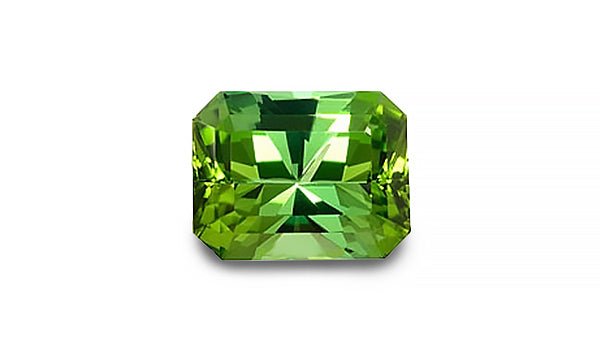
| Typical colors | Blue, golden, honey, red-orange, colorless | Green, cloudy tones |
| Fire and brilliance | Maximum | Subdued |
High zircons deliver the full optical performance and dominate fine jewelry. Low zircons, typically green, trade mainly as collector curiosities: gems slowly rewritten by their own radioactivity. The radiation levels involved are trace amounts, and normal gem zircon poses no hazard in wear.
The Oldest Gem on Earth
Zircon's scientific fame rests on the same uranium that causes metamictization. Uranium decays to lead at a precisely known rate, making zircon the reference mineral for dating the deep past. The Jack Hills crystals did more than set an age record: their oxygen isotope chemistry indicates that liquid water existed on Earth's surface over 4.3 billion years ago, far earlier than science had assumed, and a handful of sand-sized crystals quietly rewrote the story of the early planet. A zircon on the hand is, among everything else, a fragment of the deepest archive Earth keeps.
Colors and the Truth About Blue
Natural zircon spans colorless, golden, honey brown, red-orange, green, and rose tones. Blue, the color that made zircon a December birthstone and its most commercially important shade, tells a treatment story that every buyer should know: virtually all blue zircon starts as reddish-brown material, mined chiefly in Cambodia's Ratanakiri province, and is heated to around 900 to 1000 °C in an oxygen-starved atmosphere to turn blue. The treatment is stable, universal, and accepted, and it should still be disclosed as a matter of course. The wider logic is covered in our guide to treated versus untreated gemstones.
The blue itself earned a name of its own. George Frederick Kunz, the Tiffany gemologist who christened morganite, promoted blue zircon under the trade name "starlite," a label that never fully caught on but still surfaces in vintage jewelry catalogs. One caution accompanies the color: some heated blue stones can fade or revert toward brown after prolonged exposure to strong ultraviolet light, so blue zircon prefers life away from tanning beds and week-long beach windowsills.
Where Zircon Is Mined
Cambodia's Ratanakiri province supplies the material behind most of the world's blue zircon. Sri Lanka, a source for two millennia, produces fine golden, honey, and colorless stones alongside its historic Matura material. Madagascar contributes green and rare colors, often in the low-zircon category, while Vietnam, Thailand, and Myanmar round out the gem supply. Australia, the great scientific locality, dominates industrial zircon mining and holds the ancient Jack Hills crystals that made the mineral famous far beyond jewelry.
Judging Quality
Color leads value: saturated blue and vivid red-orange command the top of the market, followed by rich honey and golden tones, with pale and brownish stones accessible. Zircon is expected to be eye-clean, and its strong facet doubling rewards precise cutting; a well-oriented stone reads lively rather than blurry. Size premiums stay gentle by colored-stone standards, which makes zircon one of the best routes to genuine fire in larger sizes without diamond arithmetic.
Durability and Care
Zircon rates 6 to 7.5 on the Mohs scale depending on type, hard enough for regular wear with one caveat the trade knows well: the stone is brittle, and its facet edges abrade faster than its hardness suggests. Rings deserve protective settings and rotation out of rough duty; earrings and pendants suit it perfectly.
- Clean with lukewarm water, mild soap, and a soft cloth or brush.
- Skip ultrasonic and steam cleaners.
- Store zircon apart from harder stones, and cushion it against knocks.
- Keep heated blue stones out of prolonged intense UV exposure.
For how hardness numbers translate into daily wear, see our gemstone hardness guide.
Why Choose Zircon?
Zircon offers fire a step from diamond, a color range few species match, the deepest geological pedigree of any gem, and pricing that rewards buyers who know the difference between zircon and the synthetic that borrowed its name. It asks only for informed buying: judge by millimeters, expect heat behind every blue, and give facet edges the respect brittleness demands.
For a December birthstone, a natural alternative to diamond fire, or simply the oldest thing anyone you know will ever own, zircon earns its place. Our birthstone guide covers its calendar role.
Explore our selection of natural zircon gemstones, each described with full treatment disclosure.