Sphene: The Fiery Gemstone with Unmatched Brilliance
The Stone With Two Names and Diamond-Beating Fire
In 1982, the International Mineralogical Association struck the name sphene from its official records, ruling that the mineral must be called titanite. Four decades later, the gem trade still politely refuses to comply. Jewelers, dealers, and collectors go on saying sphene, and the reason is simple: a stone this alive deserves its own name. Few gems combine fire beyond diamond, near-metallic luster, and an optical doubling effect that makes every facet seem to vibrate.
This guide covers sphene in full: what it is and why geologists prize the same crystal jewelers facet, how its three-part optics work, how it compares with sphalerite, its only real rival for fire, what it costs, and how to own a soft, brilliant stone without regretting it.
What Is Sphene?
Sphene is a calcium titanium silicate, CaTiSiO₅, crystallizing in the monoclinic system as the sharp, flattened wedges that gave the stone its trade name, from the Greek sphenos, wedge. Its official mineralogical name, titanite, records the titanium at its core. Both names describe the same mineral, an accessory component of igneous and metamorphic rocks worldwide, of which only a whisper ever reaches gem quality.
Beyond the jewelry case, titanite performs quiet scientific service. Its structure accepts traces of uranium, which decay at a precisely known rate, making the mineral a standard tool for uranium-lead radiometric dating. The same species a cutter facets for fire serves geologists as a clock, dating mountain-building events hundreds of millions of years old. Few gems carry a second career this useful.
Why Does Sphene Have So Much Fire?
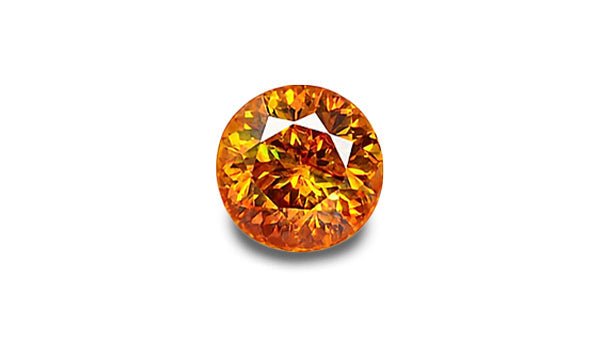
Sphene's visual character rests on three optical properties working at once, each near the top of its scale:
| Property | Sphene's value | What the eye sees |
|---|---|---|
| Dispersion | 0.051 (diamond: 0.044) | Rainbow fire exceeding diamond |
| Refractive index | 1.84 to 2.11 | Brilliant, near-adamantine luster |
| Birefringence | Up to roughly 0.13, among the strongest in gems | Visible doubling of back facets, a lively, shimmering interior |
The third row is sphene's signature. Strong double refraction splits light into two beams inside the crystal, so the back facets appear doubled when viewed through the table. In most gems such doubling would count against the stone; in sphene it merges with the fire to produce an interior that seems to move. Cutters orient the rough to keep the effect vivid without turning fuzzy, and a stone cut with that understanding looks animated in a way photographs consistently understate.
Sphene vs Sphalerite: Which Fire Gem Should You Choose?
Collectors drawn to fire eventually face the same comparison, because two stones rule the category above diamond. The choice runs on a clean trade-off:
| Trait | Sphene | Sphalerite |
|---|---|---|
| Dispersion | 0.051 | 0.156 |
| Hardness (Mohs) | 5 to 5.5 | 3.5 to 4 |
| Signature effect | Facet doubling, animated interior | Sheer volume of spectral fire |
| Wearability | Occasional jewelry with protective settings | Display and earrings, little more |
| Colors | Yellow-green, green, golden brown | Golden, orange, honey, red-brown |
| Character | The wearable one, barely | The spectacle, uncompromised |
Put simply: sphalerite triples sphene's fire and pays for it in fragility, while sphene offers most of the drama in a stone that can, with care, actually leave the house. Serious phenomenon collectors usually end up owning both, and our full sphalerite guide makes the other half of the case.
What Colors Does Sphene Come In?
Sphene spans yellow, yellow-green, green, and golden brown, with rare orange to reddish tones, and color intensity drives value. The most prized variety is chrome sphene, colored vivid green by chromium, historically associated with deposits in Baja California and matched today by fine green material from Madagascar.
The stone is also strongly pleochroic: viewed along different crystal directions it can show three distinct colors in one crystal, often near-colorless, greenish yellow, and brownish orange. Combined with the fire and the facet doubling, this gives a fine sphene a complexity of color behavior that rewards seeing the stone move in person, under more than one light source, before judging it.
Where Is Gem-Quality Sphene Found?
Madagascar leads the modern market with intensely colored green and yellow-green stones of high clarity, the source behind most fine sphene in circulation today. Sri Lanka contributes transparent yellow and green stones from its classic gem gravels, and the high-mountain pegmatites of Pakistan and Afghanistan produce material with notable fire, mined seasonally at altitudes that make every stone hard-won.
History added the rest of the map. Mexico's Baja California gave chrome sphene its reputation in the 20th century, Russia's Ural Mountains yielded the brown-green crystals of 19th-century collections, and the Alpine clefts of Switzerland and Austria produce lustrous crystals prized by mineral collectors as much as cutters. Brazil and Canada, including the classic Bancroft district of Ontario, round out the sources. Across all of them the pattern repeats: an abundant rock-forming mineral, and a rare, precious sliver of it clean enough to facet.
What Does Sphene Cost?
Sphene remains one of the fire league's quiet bargains, priced by color, clarity, and size in a steepening curve. Lighter yellow-green stones with visible inclusions start in the tens of dollars per carat, clean and well-cut yellow-greens in the one to three carat range typically trade in the low hundreds per carat, and the market's top belongs to saturated green material: fine chrome sphene and clean stones above three carats climb toward the high hundreds, with exceptional large greens reaching four figures per carat. Because clean rough above five carats is genuinely scarce, size compounds every other factor faster here than in most species.
Set against what the money buys, more fire than diamond in a natural, untreated stone, the prices explain why sphene keeps converting first-time viewers into collectors.
How Durable Is Sphene, Really?
The honest answer has two halves. At 5 to 5.5 on the Mohs scale, sphene sits below household dust's quartz content, so an exposed table worn daily will slowly lose its razor polish, and facet junctions abrade first. The stone is also brittle, with distinct cleavage, so a sharp knock risks more than a scratch. Rings therefore call for protective bezels and occasional-wear status; earrings, brooches, and pendants suit the stone naturally.
The second half is the consolation most guides omit: softness cuts both ways. A sphene that has dulled after years of enjoyment can be professionally repolished at modest cost, restoring the full fire, something no owner of a chipped brittle gem can say. Treated as an evening stone and refreshed once a decade, a sphene outlives the caution around it. For how hardness numbers translate into daily reality, see our gemstone hardness guide.
How Should You Clean Sphene?
By hand, and only by hand: lukewarm water, mild soap, a soft cloth or brush, a thorough rinse. Ultrasonic cleaners are excluded absolutely, since vibration is exactly what cleavage-prone stones tolerate worst. Some sources suggest steam cleaning may be acceptable; we advise against it, because steam combines heat shock and pressure, two stresses a brittle, cleavable gem should never meet. The stone stores separately from harder gems, ideally in its own soft pouch, and comes off before sport, housework, or gardening.
Is Sphene Worth Collecting?
Sphene offers fire beyond diamond, luster close behind it, an interior animation no other affordable gem can match, and a natural, untreated character in a package rare enough that most jewelers have never stocked one. It asks for informed ownership in return, and rewards it with one of gemology's most engaging stones, a gem that changes with every light source and every degree of movement.
For a collection organized around optical phenomena, sphene and sphalerite form the natural pair: the two gems that beat diamond at its own game, each in its own way, one built for the display case and one that, handled with respect, gets to come along for the evening.
Frequently Asked Questions About Sphene
Is sphene the same as titanite?
Yes. Titanite has been the official mineralogical name since 1982, when the International Mineralogical Association discontinued sphene, but the gem trade has kept the older name in continuous use. Both refer to the same calcium titanium silicate.
Does sphene have more fire than diamond?
Yes. Sphene's dispersion measures 0.051 against diamond's 0.044, so a well-cut stone shows stronger rainbow fire. Among collectible gems, only sphalerite disperses light more strongly.
Why do sphene facets look doubled?
Sphene has one of the strongest birefringence values in gemology, up to roughly 0.13. Light splits into two beams inside the crystal, so back facets appear doubled through the table, giving the stone its characteristic lively, shimmering interior.
What is chrome sphene?
Chrome sphene is the vivid green variety colored by chromium, the most valuable form of the stone. It became famous through deposits in Baja California, and fine green material from Madagascar leads the modern market.
What does sphene cost?
Included yellow-green stones start in the tens of dollars per carat, clean well-cut stones of one to three carats trade in the low hundreds per carat, and fine chrome sphene or clean stones above three carats climb toward the high hundreds, with exceptional large greens reaching four figures per carat.
Can sphene be worn in a ring?
Occasionally and in a protective bezel. At hardness 5 to 5.5 with distinct cleavage, sphene dulls and chips under daily wear, though a dulled stone can be professionally repolished to full fire. Earrings, brooches, and pendants suit it best.
How should sphene be cleaned?
Only by hand with lukewarm water, mild soap, and a soft cloth. Ultrasonic cleaners must never be used, and despite occasional advice to the contrary, steam cleaning should also be avoided, since heat shock and pressure are exactly the stresses a brittle, cleavable stone tolerates worst.
Explore our selection of natural sphene gemstones, each described with full disclosure of origin and characteristics.