Cabochon: The Cut That Turns Inclusions Into the Point
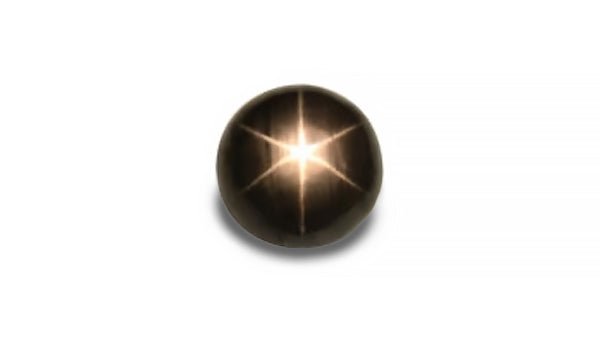
A star sapphire cut flat has no star. The six rays are reflections from three sets of microscopic rutile needles inside the crystal, and they only converge into a star when a curved surface gathers them and the dome sits square to the needles. Cut the same rough into a faceted stone and the needles become haze. That is the whole argument for the cabochon in one example: the dome is an optical instrument, chosen for what a particular stone does with light.

A six-rayed star on a pink sapphire cabochon. The rays meet where the dome is highest, and they disappear the moment the light source is diffused.
Why the round cut came first
For most of the history of jewelry there was no alternative. Grinding a smooth curve into a hard stone needs patience and an abrasive, while cutting accurate flat faces at controlled angles needs geometry, tooling, and an understanding of how light refracts. Faceting appears in Europe during the fourteenth and fifteenth centuries and matures over the next three hundred years, ending in the brilliant cut.
What happened next is worth stating plainly, because the trade rarely does. Faceting suited transparent stones so well that it became the default for everything, and the cabochon acquired a reputation as the cheaper option. That reputation is a marketing accident. The two cuts answer different questions, and the faceted side of the story is told in The Art of the Gemstone Cut.
What a dome does that facets cannot
A faceted stone works by internal reflection. Light enters through the table, bounces off the pavilion facets, and returns to the eye as brilliance. The design assumes the light will travel through the stone unobstructed, which is why inclusions are penalized in transparent material.
A cabochon works by gathering. The curved top collects light from many angles and returns it from inside the body of the stone, so whatever is suspended in there becomes part of the effect. Inclusions stop being flaws and start being the point.
| Optical effect | What causes it | Typical species |
|---|---|---|
| Asterism, the star | Reflections from oriented needle inclusions | Sapphire, ruby, garnet, diopside |
| Chatoyancy, the cat's eye | One set of parallel fibres or tubes | Chrysoberyl, tourmaline, quartz |
| Adularescence | Light scattering between microscopic layers | Moonstone |
| Play of colour | Diffraction from stacked silica spheres | Opal |
| Even body colour | Translucency without transparency | Chrysoprase, gem silica, turquoise, jade |
Orientation is where the skill lives. A star or an eye appears in one plane only, and the cutter has to read the rough, find that plane, and set the dome perpendicular to it. Get it wrong by a few degrees and the star sits off centre, permanently. Dome height then controls the character of the effect: a high dome tightens the star and sharpens the eye, a shallow dome spreads both and loses definition. Two cabochons from the same piece of rough can differ in price by a multiple because of these two decisions.
The back of the stone tells you more than the front
Turn a cabochon over. The base should be flat or gently curved, evenly finished, and free of the pits left by rushed polishing. Three things worth noticing when you do.
A hollowed back is common in dark material. Scooping out the underside lets more light through and lightens the apparent colour, which is legitimate work and also means the stone weighs less than its face-up size suggests. A backing layer, whether black paint, foil, or cement, has a different purpose and belongs in the disclosure. And a seam running around the girdle or across the base signals an assembled stone rather than a single piece.
Assembled stones are standard practice in opal, where a thin slice of precious material is bonded to a dark backing as a doublet, or capped with clear quartz as a triplet. Both are honest products at honest prices when they are described accurately, and both are worth a fraction of a solid stone of the same size. The distinction is covered in the opal profile.
Weight and size part company
Carat is a unit of mass. In a faceted stone cut to standard proportions, weight predicts face-up size reasonably well. In a cabochon it does not, because the dome can hold a great deal of material that contributes nothing to how large the stone looks on the hand.
The practical consequence: compare cabochons by millimetre dimensions first and by carat weight second. A 10 by 8 millimetre oval with a modest dome and one with a tall dome can differ by half again in weight while looking identical from above. Why carat weight misleads in several other ways is set out in Carats Explained.

Illustration: two cabochons of identical width, one with a low dome and one with a high dome. Seen from above they look the same size, and the weights can differ by half again.
Treatment questions specific to this cut
Because cabochons are used for opaque and included material, they attract treatments that faceted goods rarely see. Dye takes readily in porous stones such as chalcedony and turquoise, and it usually gathers in fractures and along the base instead of sitting evenly through the body. Impregnation with wax, resin, or polymer stabilizes soft or crumbly material so it can be cut at all. Diffusion produces star effects in corundum that the crystal never had, and an assembled star stone with a synthetic top over natural material is a different product again.
None of this makes a stone dishonest. Undisclosed treatment does. Any of these should be stated on the listing, and the general framework is in Treated vs. Untreated Gemstones. For a star stone in particular, ask directly whether the asterism is natural, and expect the answer in writing. The blue star sapphire profile covers what a natural star looks like next to an induced one.
Famous stones that were never faceted
The Star of India, a 563 carat grey star sapphire in the American Museum of Natural History, remains the best known cabochon in the world. The Rosser Reeves ruby at the Smithsonian, 138.7 carats, is celebrated for a star of unusual sharpness and centring. The large red spinel in the Imperial State Crown, long called the Black Prince's Ruby, is polished rather than faceted and carries a drilled hole from its earlier life as a bead.
The pattern in that list is not accidental. Each of those stones would have lost the quality it is famous for under a faceting wheel.
Choosing and caring for a cabochon
Look at the dome from directly above and check that it is symmetrical, then tilt it and watch how the highlight travels. A well cut dome moves light smoothly. Flat spots, an off centre apex, and a girdle of uneven thickness are the common faults, and they are cutting errors rather than material faults.
Judge colour in daylight and in shade. Translucent material that looks alive in one and dead in the other is telling you something the photograph did not. Where the stone shows a star or an eye, use a single point light source, because diffuse light softens both and flatters weak examples.
Durability follows the species instead of the cut, so a chalcedony cabochon and a turquoise cabochon need different care. What the cut adds is exposure: the dome stands above the setting and takes contact that a faceted stone set flush would avoid, which is why a bezel earns its keep on a ring worn daily. Skip ultrasonic and steam cleaning on any stone that may be impregnated, backed, or assembled, and use warm water, mild soap, and a soft cloth. The hardness question is explained in Understanding Gemstone Hardness, and general handling in Gemstone Care.
Frequently asked questions
Are cabochons worth less than faceted stones?
Not as a rule. Price follows the material and the quality of the work. Fine star sapphire, gem silica, jadeite, and black opal are all cabochon goods and all trade well above ordinary faceted stones. Cheap cabochons exist because cheap material is often opaque, which is a fact about the material rather than the cut.
Why are star and cat's eye stones always cut as cabochons?
Because the effect needs a curved surface. The rays come from reflections off oriented inclusions, and only a dome gathers them into a single figure. A flat table scatters the same reflections into haze.
What does a hollowed back mean?
The cutter removed material from the underside to let more light through, which lightens the apparent colour of dark rough. It is normal work. It also means the stone weighs less than a solid cabochon of the same dimensions, so compare by millimetres.
How can I tell a solid opal from a doublet or triplet?
Look at the side of the stone for a straight seam where the layers meet, and at the back for a uniform dark plane. A triplet adds a clear cap with a second seam near the top. Both are legitimate when described as such and are worth considerably less than solid material.
Does a taller dome mean a better stone?
It means a different one. Height sharpens a star or an eye and deepens colour, and it also adds weight that does not show face up. For an even coloured translucent stone a lower dome often reads better.
Can a cabochon be worn every day?
Yes, if the species allows it. Durability comes from the mineral rather than the shape, so a quartz cabochon handles daily wear while a turquoise or malachite cabochon needs protection. The raised dome takes more contact than a faceted stone, which a bezel setting solves.
Are star effects ever artificial?
Yes. Diffusion treatment can create asterism in corundum, and assembled stones with a synthetic star top over a natural base circulate in the trade. Ask whether the star is natural and expect the answer in the documentation.
How should I compare two cabochons?
Start with millimetre dimensions rather than carat weight, then judge colour in two lighting conditions, then check the dome for symmetry and the back for seams or backing. Carat weight is the last thing to look at, not the first.
The cut is a decision about light, made once, permanently, by whoever held the rough. Our loose natural stones are in the gemstones collection, where cabochon shapes can be filtered directly.