Sphalerite: The Fiery Gem of Brilliance and Light
The Gem That Outfires Diamond Three Times Over
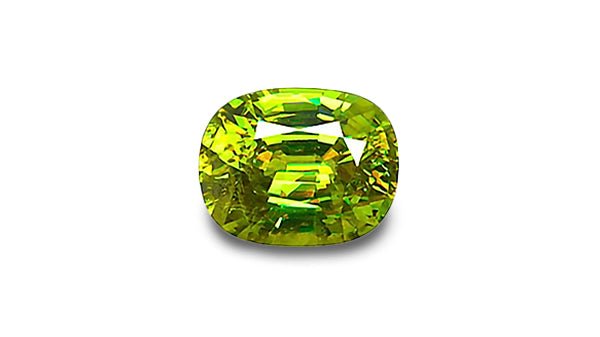
If fire alone set a gemstone's price, sphalerite would outsell diamond. Its dispersion, the optical property that splits white light into rainbow flashes, measures 0.156 against diamond's 0.044, more than three times higher, and no collectible gem on earth comes close. A fine golden sphalerite under a single spotlight throws broad, saturated flashes of red, orange, and green across its entire face, a show most jewelers have never had in stock and most collectors have never seen in person.
The reasons it costs a fraction of diamond, and the reasons so few people have ever handled one, are the real story of this stone. This guide covers all of it: what sphalerite is, why cutting it ranks among the hardest jobs in the lapidary trade, why the world's finest deposit sits inside a national park, how gemologists identify it, and, because this gem rewards it more than any other, how to light and display one properly.
What Is Sphalerite?
Sphalerite is zinc sulfide (ZnS) and, before it is anything to a jeweler, it is the world's principal ore of zinc. Miners have processed it by the millions of tonnes for galvanized steel and brass; transparent gem crystals are freak occurrences within those ore bodies, which is the first reason faceted sphalerite is rare.
The stone carries deception in its name twice over. The Greek sphaleros means deceptive, and the old German miners' term Blende, still alive in the ore name zinc blende, comes from blenden, to deceive, because the mineral resembled valuable lead ore yet yielded no lead. Both names record centuries of miners being fooled by the same stone that now fools the eye in a different way, with fire that seems impossible for its price.
Chemistry decides which sphalerite becomes a gem. Pure zinc sulfide is nearly colorless, a rarity collectors call cleiophane. As iron substitutes for zinc in the crystal, the color deepens through honey yellow, golden orange, and red-brown toward the opaque black ore variety known as marmatite. Gem material is the low-iron exception: transparent, warm, and scarce even within a scarce category.
Why Does Sphalerite Sparkle More Than Diamond?
Dispersion measures how strongly a material separates white light into its spectral colors, and the higher the number, the more rainbow fire a cut stone can display. Sphalerite's refractive index of roughly 2.37 approaches diamond's 2.42, giving it a true adamantine luster, and its dispersion stands alone among gems of any availability:
| Gemstone | Dispersion | Fire relative to diamond |
|---|---|---|
| Diamond | 0.044 | Reference |
| Sphene | 0.051 | Slightly higher |
| Demantoid garnet | 0.057 | Noticeably higher |
| Sphalerite | 0.156 | More than three times higher |
The two runners-up in the fire league, sphene and demantoid, are themselves celebrated precisely for this property, and sphalerite roughly triples them. In practice the numbers translate into something photographs consistently understate: where a diamond flashes pinpoints of spectral color, a well-cut sphalerite paints in whole panels of it.
Why Is Faceted Sphalerite So Rare?
Two bottlenecks stand between the ore and the display case, and each would be limiting on its own.
The first is geological. Gem-grade transparency requires low iron, clean growth, and crystal size, a combination the world's zinc deposits almost never deliver together. Out of an industrial commodity mined by the megatonne, facetable rough amounts to a rounding error.
The second bottleneck works at the cutting bench. Sphalerite has perfect cleavage in six directions, meaning the crystal wants to split cleanly along six built-in planes, and a wrong vibration at the wheel can halve a stone in an instant. Add hardness of only 3.5 to 4 on the Mohs scale, softer than a copper coin, and every stage becomes a controlled risk: cutters work with slow wheel speeds, gentle laps, and constant attention to cleavage orientation, and the polish that makes the fire visible demands more patience than almost any other gem. Damaged stones are routinely recut smaller rather than repaired. Cutters who master the material earn a quiet distinction in the trade, and our article on the art of the gemstone cut explains why such decisions shape everything a stone becomes.
Where Does Gem Sphalerite Come From?
As zinc ore, sphalerite occurs worldwide. As a gem, it effectively belongs to one mountain range and a short list of runners-up.
The benchmark is Spain. The Áliva mines, high in the Picos de Europa mountains of Cantabria at around 1,800 meters, produced the transparent golden and orange material against which all sphalerite is judged, including the largest clean stones ever faceted. The deposit's location now doubles as its scarcity story: the Picos de Europa are a national park, active mining ended decades ago, and fine Spanish sphalerite trades today largely from older stocks and recut stones. A supply that was already a geological accident has become, in practical terms, a closed edition, the same structural scarcity we describe in our guide to what makes a gem rare.
Mexico contributes rich red-brown and golden stones from its silver-lead-zinc districts, the American Tri-State field of Missouri, Kansas, and Oklahoma yielded lustrous "ruby jack" crystals alongside galena during its mining century, and Bulgaria's Madan ore field occasionally surprises with facetable material. None of them replaces Spain at the top.

Star of Asturias, 163.4 ct, among the largest faceted sphalerites in the world.
How Do You Judge Sphalerite Quality?
Transparency leads. Fire needs a clear path through the stone, so eye-visible clouds and fractures cost sphalerite more than they cost most gems. Color follows, with clean golden orange at the top of the scale, honey and yellow-green close behind, and dark brown material remaining an ore statistic rather than a gem. Spanish provenance carries a premium of its own, partly for color and partly for the closed-source story above.
Cut quality matters unusually much. Only precise angles convert the stone's optics into visible fire, and a windowed or lifeless cut wastes the one property that makes sphalerite worth owning; because the material resists calibrated cutting, most fine stones are freeform or precision one-off cuts, and that individuality is part of the category's character. Size amplifies everything: clean faceted stones above five carats are genuinely scarce, above twenty carats they enter museum territory, and the record pieces, like the Star of Asturias, are named the way important diamonds are.
What Does Sphalerite Cost?
Sphalerite pricing follows a simple structure with a steep top end. Entry-level collector stones, smaller, browner, or visibly included, start in the tens of dollars per carat, making the species one of the cheapest tickets into serious optical phenomena. Clean golden and orange stones in the two to five carat range climb into the low hundreds per carat, and the market's summit belongs to large, transparent Spanish material: fine stones above ten carats trade in the thousands, with named museum-grade pieces valued like the rarities they are.
Three multipliers drive the curve: transparency first, since fire needs a clear path; saturated golden-orange color second; and size third, because clean large crystals of a soft, cleavable ore mineral border on geological luck. Spanish provenance adds its own premium on top, part color, part closed-source history. Set against its neighbors in the fire league, the pricing reads almost like a mistake: a sphalerite with triple the dispersion of a fine demantoid typically costs a small fraction of it, and wearability, the one thing sphalerite lacks, explains the entire gap.
How Do Gemologists Identify Sphalerite?
Sphalerite gives itself away in the laboratory by exceeding the instruments. A standard refractometer reads only to about 1.81, so a sphalerite returns the result "over the limit," which, combined with its adamantine luster, strong fire, and density of roughly 3.9 to 4.1, narrows the field to a handful of candidates fast. Under long-wave ultraviolet light many stones fluoresce orange, and the mineral holds one more party trick: many sphalerites are triboluminescent, emitting brief orange flashes when scratched or scraped in the dark, a property shared by only a handful of minerals. A gem that sparks when provoked suits its deceptive name well.
For a buyer, the practical point is simpler: sphalerite's look-alikes, sphene, zircon, and even diamond in older estate settings, are all harder than it is. Any competent gemologist separates them in minutes, and a stone sold as sphalerite at sphalerite prices carries little incentive for fakery. Certification matters here mainly to confirm the absence of treatments and to document weight and origin claims.
Can You Wear Sphalerite?
Honestly: barely, and knowingly. At hardness 3.5 to 4 with perfect cleavage, sphalerite is unsuited to rings and daily wear; ordinary household dust, rich in harder quartz particles, will dull an exposed table over time, and a knock against a door frame can do worse. It belongs in earrings, in pendants worn for occasions, and above all in the display case.
- Clean only with a soft cloth and lukewarm water; skip all chemicals.
- Never use ultrasonic or steam cleaners.
- Protect the stone from knocks and temperature shocks, which can trigger cleavage.
- Store it alone, in a soft pouch, away from every harder stone.
Collectors accept these terms the way vintage car owners accept garages. The stone was never meant for the daily commute.
How Should You Light and Display Sphalerite?
This is the section most guides skip, and for sphalerite it decides everything, because the stone's personality changes with the light source more than any gem in common circulation. In diffuse daylight or broad office lighting, sphalerite looks like a pleasant golden stone with a glassy luster and keeps its fire to itself. Under a single small, bright source, a halogen spot, a narrow-beam LED, or low evening sunlight, the dispersion wakes up and the stone throws its full spectral display.
For display, that means one rule: point light beats bright light. A single adjustable spot at a few watts will outperform a flood of ambient illumination every time. Collectors who show sphalerite well typically place it on a dark, non-reflective base with one directional source slightly off-axis, so the flashes travel as the viewer moves. If you own one stone that earns this treatment, it is this one; the difference between casual and correct lighting on a fine sphalerite is the difference between glass and fireworks.
Is Sphalerite Worth Collecting?
Sphalerite offers the single most dramatic optical show in the gem world, from a source that has effectively stopped producing, in a package most people will never encounter outside a museum. It asks for a collector's mindset in return: careful handling, occasional wear, proper light. For a collection organized around optical phenomena, sphalerite and sphene form a natural pair, the two gems that beat diamond at its own game, and one fine sphalerite teaches more about what dispersion means than a tray of conventional stones.
Frequently Asked Questions About Sphalerite
Does sphalerite really have more fire than diamond?
Yes. Its dispersion of 0.156 stands more than three times above diamond's 0.044, and a well-cut stone shows broader, more saturated rainbow flashes than any diamond can.
Why is sphalerite so inexpensive if it is so rare?
Softness sets the ceiling. At hardness 3.5 to 4 with perfect cleavage, sphalerite cannot serve as everyday jewelry, and gems priced for wearability discount what cannot be worn. Collectors treat that discount as the bargain of the fire league.
Can sphalerite be set in a ring?
It can be set, and it will suffer. Rings expose the stone to exactly the knocks and abrasion it tolerates worst. Earrings, occasional pendants, and display are the honest uses.
Where does the best sphalerite come from?
The Áliva mines in Spain's Picos de Europa produced the finest transparent golden material ever found. The area is now a national park with mining long ended, so fine Spanish stones trade largely from older stocks.
Is sphalerite treated?
No routine treatments exist for sphalerite. Its color and clarity are natural, which keeps disclosure simple: certification serves mainly to document identity, weight, and origin.
How can I tell sphalerite from sphene or citrine?
Sphene shows visible doubling of its back facets and is noticeably harder; citrine is quartz, far harder still, with a fraction of the fire and an ordinary refractometer reading. Sphalerite combines adamantine luster, extreme fire, an over-the-limit refractive index, and softness no common look-alike shares, so a gemologist separates them in minutes.
What is triboluminescence in sphalerite?
Many sphalerites emit brief orange flashes of light when scratched or scraped in the dark, one of only a handful of minerals with this property. Many also fluoresce orange under long-wave ultraviolet light.
Explore our selection of natural sphalerite gemstones, each described with full disclosure of origin and characteristics.