Black Star Sapphire Information
Every rule the sapphire world lives by, the black star sapphire breaks. Sapphires are prized for color; this one has none worth speaking of. Star sapphires shine with a silvery-white star; this one's is gold. The species is mined on five continents; the gold-starred black stone comes essentially from one Thai province. And where a classic star floats on the surface like a reflection, the black star's rays behave like something lit inside the dome. It is corundum's most eccentric member, and once you understand why, it becomes one of the most interesting stones a modest budget can buy.
A Different Star, Built From a Different Mineral
Classic star sapphires owe their asterism to needles of rutile, a titanium mineral that reflects white light and produces a silvery star, as explained in our profile of blue star sapphires. Black star sapphire is built from something else entirely: platelets of hematite and ilmenite, iron and iron-titanium oxides that exsolved from the crystal as it cooled deep in Thai basalt. They arrange themselves in the same three directions the crystal's trigonal geometry allows, crossing at sixty degrees, and they reflect light like tiny metallic mirrors. Metal reflects warm, and that is the whole secret of the gold star: the rays take their color from the mineral doing the reflecting, not from the sapphire around them.
The same iron-rich chemistry that supplies the platelets also drowns the body color, which is why these stones are black to very dark brown-green rather than blue. The gem is dense with inclusions by any normal standard, and every one of them is working. This is corundum turned inside out: an opaque stone whose value lies entirely in what it contains.
One Province, One Gem
The gold-starred black sapphire is a Thai speciality, coming above all from the basalt-hosted deposits of Chanthaburi province in the southeast, near the Cambodian border, where the mining town of Bo Rai and the surrounding fields fed Thailand's rise as the world's corundum trading and cutting capital. Black star material was for decades the everyday cousin of that trade, cut in quantity, set into silver and gold, and sold in the Bangkok markets to travelers who had never seen a golden star before.
Small production continues, and the stone has held a curious position ever since: genuinely singular, geologically restricted, and still affordable, because the corundum world prices color first and this gem declines to compete on that ground at all. It is one of the few places in the sapphire family where a striking, phenomenal, natural stone remains within easy reach, which is precisely what makes it worth knowing about.
Judging a Black Star
The trade-off that governs blue stars, star strength against body color, barely applies here, since there is no color to sacrifice. Judgment concentrates almost entirely on the star and the dome:
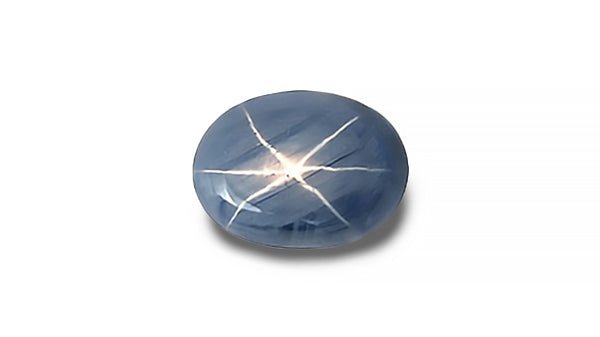
- The rays. Six of them, straight, of even length, meeting at a center that sits in the middle of the dome. In the finest stones the rays extend cleanly to the edge.
- The gold. The best stars are a warm, bright metallic gold that reads unmistakably against the black. Weak, grayish, or washed-out rays are the commonest fault.
- The movement. The star must glide across the dome as the stone tilts, staying assembled and centered.
- The surface. Polish matters more here than in almost any faceted gem, because the star is a reflection and a dull or pitted dome scatters it.
- The shape. A symmetrical cabochon with a proportionate dome; flat domes give flat stars, and excessive height buries weight where nobody sees it.
Two viewing notes save disappointment. Use a single point of light, a penlight, a phone torch, or direct sun, since diffuse indoor lighting weakens any star. And look at the stone from directly above; unlike a blue star, whose rays sit on the surface, a black star's metallic reflections can appear to hover slightly within the dome, an effect that rewards a slow tilt in the hand.
Treatment and Imitation
Natural black star sapphire is normally untreated, for the same reason as any star stone: heat destroys the very inclusions that build the star, so heating this gem would be an act of self-sabotage. What the buyer must watch for instead is the imitation trade. Synthetic star sapphires with manufactured stars have been produced since the 1940s, black glass and doublets with painted or applied stars circulate in tourist markets, and diffusion treatment can create a star in a thin surface layer of poor material. The tells are the usual ones: a star that is too sharp, too perfectly centered, and unwavering, on a body that looks flat and uniform under a loupe. Nature is less tidy than a factory. The general framework for disclosures is covered in treated versus untreated gemstones, and for a stone of any value a laboratory report confirming natural corundum settles the question, as explained in how to read a gem certificate.
Wearing a Black Star
Corundum brings the same gifts to this stone as to every other: hardness of 9, no cleavage, and a temperament that shrugs off daily wear. The gold star is made for warm metals, and the classic setting is yellow gold, where the rays and the mounting speak the same language; bezels and low-profile settings protect the dome and make it easy to tilt the stone toward a light, which is what owners of star stones do constantly. Clean with warm water, mild soap, and a soft brush, and keep any stone of uncertain treatment away from ultrasonic cleaners and jeweler's heat. The gem is a favorite in men's rings for exactly the reasons it is unusual: dark, geometric, unmistakably natural, and quietly theatrical when it catches the sun.
As a sapphire, the black star shares the species' September birthstone, as covered in our guide to birthstones. The wider corundum palette, and where the phenomenal stones sit within it, is mapped in our guide to fancy sapphires.
Explore our sapphire collection, where the phenomenal stones appear alongside the faceted gems.
Frequently Asked Questions
Why is the star in a black star sapphire gold?
Because it is built from different minerals. The star comes from platelets of hematite and ilmenite, iron-bearing oxides that reflect light with a warm metallic sheen, while classic star sapphires use rutile needles that reflect white. The ray takes its color from the mineral doing the reflecting.
Where do black star sapphires come from?
Essentially one place: the basalt-hosted deposits of Chanthaburi province in southeastern Thailand, around Bo Rai and the surrounding fields. The gold-starred black stone is a Thai speciality with no significant competing source.
Is black star sapphire a real sapphire?
Yes, fully. It is corundum, the same mineral as every blue sapphire and ruby, with hardness 9 and no cleavage. Its iron-rich chemistry supplies both the dark body color and the inclusions that create the star.
Are black star sapphires treated?
Normally not, because heating would destroy the inclusions that make the star. The risks lie in imitation instead: synthetic star sapphires, glass doublets with applied stars, and surface diffusion treatments, all of which a laboratory identifies.
How do I see the star properly?
Use a single point of light, a penlight, a phone torch, or direct sunlight, held above the stone, and tilt it slowly. Diffuse indoor lighting weakens the star in every phenomenal gem, which is why these stones look dull in showrooms and come alive outdoors.
Why is black star sapphire so affordable?
Because the corundum market prices color first, and this gem has none to sell. Its value rests on a phenomenon rather than a hue, which leaves a geologically restricted, genuinely singular natural stone within easy reach.
What should I look for when buying one?
Six straight, evenly spaced rays of bright metallic gold, centered on the dome and reaching the edges, gliding smoothly as the stone tilts, on a well-polished, symmetrical cabochon. Weak or grayish rays and off-center stars are the faults that cost value.
Is black star sapphire good for a ring?
Excellent, and it is a favorite in men's rings. At 9 on the Mohs scale with no cleavage, it handles daily wear, and a bezel or low-profile setting in yellow gold protects the dome while flattering the golden star.