Tanzanite: The Mysterious African Gemstone, Its History, Legends, and Investment Value
Tanzanite: Discovered in 1967 Below Kilimanjaro
The story the Maasai tell begins with lightning. A grass fire swept the plains below Kilimanjaro, and when herders returned with their cattle, brown crystals scattered on the ground had turned a blue-violet no one had seen before. Geology tells the same story in different vocabulary: gentle heat transforms brown zoisite into blue. In 1967, a Maasai tribesman named Ali Juuyawatu shared such crystals with Manuel de Souza, a tailor and part-time prospector, who registered mining claims convinced he had found a new sapphire deposit.
The laboratories returned a stranger verdict. The stones were zoisite, a calcium aluminum silicate known to science since 1805 and never before seen in transparent blue. Trace vanadium, folded into the rock by a tectonic collision dated to roughly 585 million years ago, had created a gem the market had no name for.
How Tanzanite Got Its Name
The name it did have was a commercial problem. Tiffany & Co., which recognized the stone's potential immediately, judged that "blue zoisite" sounded uncomfortably close to "blue suicide," and in 1968 introduced the gem under a name of its own invention: tanzanite, after the only country on earth that produces it. The campaign line wrote itself, and Tiffany used it: tanzanite could be found in exactly two places, "in Tanzania and at Tiffany's."
Where Tanzanite Comes From: One Hill on Earth
Marketing rarely tells the geological truth; this time it did. More than fifty years of prospecting have added no second source, and every tanzanite ever sold comes from a single deposit in the Merelani Hills of northern Tanzania, an area roughly four kilometers long and two wide in the foothills of Kilimanjaro. The specific collision within the Mozambique Belt that folded vanadium-bearing rock into exactly the right chemistry happened once, and the earth has not repeated the experiment anywhere since.
Tanzania treats the gem as the national asset it is: mining blocks are licensed, a perimeter wall surrounds the deposit, and export rules keep the cutting of larger rough at home. Just how far this single-source scarcity runs, including the arithmetic behind the famous comparison with diamonds, is analyzed in our dedicated study, Tanzanite Rarity: Why This Single-Source Gem Is 1000× Rarer Than Diamonds.
Tanzanite Color and Trichroism
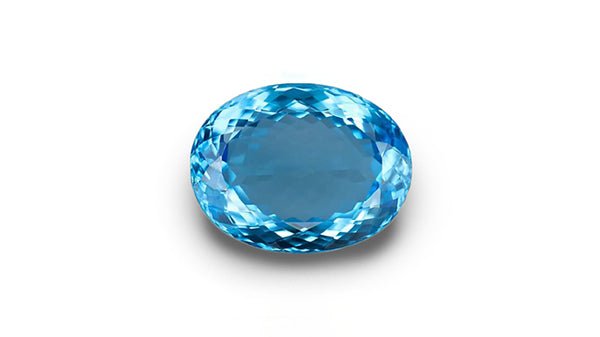
A tanzanite crystal on the cutting bench holds three gems at once. The mineral is strongly trichroic: viewed along one axis it shows blue, along another violet, along the third a brownish red. The cutter's orientation decides the face-up color of the finished stone, and the decision carries a cost in carats, because cutting for the purest blue usually sacrifices more rough than cutting for violet. Every tanzanite on the market embodies that trade, made stone by stone, between color and yield.
Color also keeps a quiet relationship with size. Saturation builds with volume, so small stones lean pale lavender while the same material above several carats deepens into the velvety blue-violet the gem is famous for. Buying larger, in tanzanite, is buying bluer.
Tanzanite Heat Treatment: What Buyers Should Know
Before the cutter chooses an axis, heat has usually already spoken. Nearly all tanzanite is gently warmed to around 600 °C, mild by gem-treatment standards, which clears the brown component and lets the blue-violet stand alone, permanently and stably. The trade accepts the practice universally; unheated blue stones exist as scarce collector items and are identified as such by laboratories. The honest sentence every seller owes the buyer is short: assume heat, expect disclosure. The wider principles are covered in our guide to treated versus untreated gemstones.
Famous Tanzanite Finds
Merelani keeps producing stories along with stones. In 2005 the mines yielded the Mawenzi, a rough crystal of 16,839 carats, more than three kilograms, named after Kilimanjaro's second peak. In June 2020, a small-scale miner named Saniniu Laizer unearthed two rough tanzanites weighing 9.27 and 5.1 kilograms, sold them through the government buying office for about 3.4 million dollars, and told reporters he planned to build a school.

Tanzanian miner Saniniu Laizer found two massive rough tanzanites weighing 9.27 kg and 5.1 kg, which he sold to the government for about 3.4 million dollars.
The Queen of Kilimanjaro, a 242-carat faceted stone set in a tiara with diamonds and tsavorite garnets, represents the polished end of the same hill.

Queen of Kilimanjaro. The tiara is part of the private collection of Michael Scott, the first CEO of Apple.
How to Choose Tanzanite: Quality Factors
Color leads value: the deeper and more saturated the blue-violet, the finer the gem, with intense blue face-up color at the summit and pale lavender at the accessible end. Tanzanite is expected to be eye-clean, and its generous crystal sizes keep large, clean stones within reach in a way corundum never allows, which is why the species has become the natural first major stone for many collectors. For a step-by-step buying method covering color grades, cut, and sizing, see our guide on how to choose a tanzanite.
Tanzanite Durability and Care
Zoisite rates 6 to 6.5 on the Mohs scale and carries perfect cleavage in one direction, so tanzanite asks for informed wear rather than fear: pendants and earrings suit it perfectly, rings belong in protective settings and come off before sport or heavy work. Clean the stone only with warm water, mild soap, and a soft cloth, never with ultrasonic or steam machines, and store it away from harder gems. For what hardness numbers mean in practice, see our gemstone hardness guide.
Why Tanzanite Belongs in a Collection
A gem discovered within living memory, from one hill, on a finite clock: the mines go deeper every year, and no second deposit has been found in over half a century of looking. Its modern standing carries one more date worth knowing: in 2002, tanzanite was added to the official birthstones for December, the first change to the list since 1912, a fitting milestone for the youngest major gemstone in the world. Our birthstone guide covers the calendar.
Tanzanite's story needs no embellishment, and at SOSNA Gems it is sold the way the story deserves: heat disclosed, origin certain, each stone documented.
Explore our collection of natural tanzanite gemstones, each described with full treatment disclosure.