Why Certification Matters – Confidence You Can Hold in Your Hands
Introduction: The Difference Between Belief and Knowledge
Two blue sapphires sit side by side. Both are three carats, both a rich cornflower blue, both beautifully cut. One sells for four thousand dollars, the other for sixty thousand. Nothing your eyes can do will explain the gap, because the difference lives in two lines of text on a laboratory report: one stone is unheated Kashmir, the other is heated Thai material.
This is the whole case for certification in a sentence. In colored gemstones, the most valuable facts are invisible. Treatment status, geographic origin, and natural versus synthetic identity cannot be seen, only tested, and they routinely change what a stone is worth by multiples. A certificate converts belief into knowledge.
What a Gemstone Certificate Actually Is
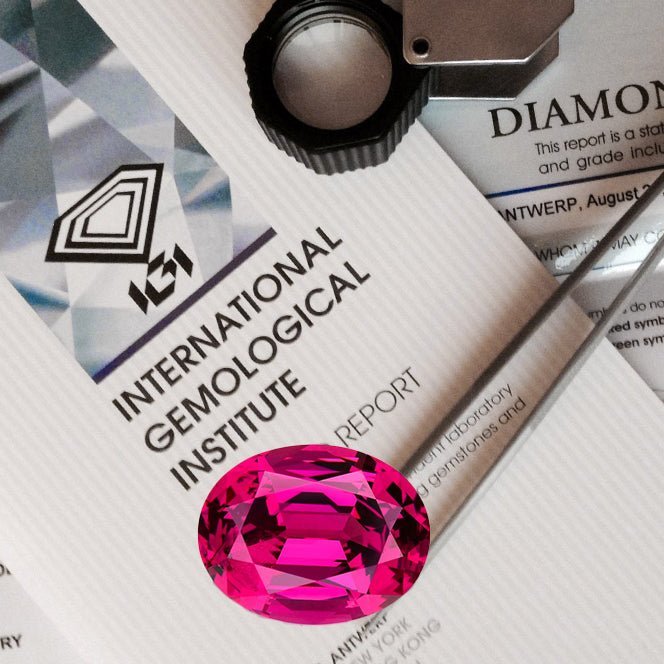
A gemstone certificate, properly called a gemological report, is a document issued by an independent laboratory that examined the stone with instruments the eye cannot replicate: microscopes, spectrometers, refractometers, and increasingly advanced chemical analysis.
A complete report states:
- Species and variety, and whether the stone is natural or synthetic
- Carat weight and precise measurements
- Cut, shape, and proportions
- Color description and clarity characteristics
- Treatment status, including type and extent
- Geographic origin, where the laboratory can determine it
Two boundaries define what a report is for. It states facts rather than opinions about price: a laboratory report is never a valuation, and any document that tells you what a stone is worth is an appraisal, a different instrument with a different purpose. And it describes the stone as it existed on the day of examination, which is why condition and documentation must stay aligned over time.
Why the Invisible Facts Decide the Price
Three questions carry most of the value in a colored gemstone, and none of them can be answered by looking.
Natural or Synthetic?
Laboratory-grown corundum has existed since 1902 and laboratory-grown emerald since the 1930s. Modern synthetics are chemically identical to natural stones, look identical to the unaided eye, and cost a tiny fraction of the price. Only instruments detect the growth features that separate them. Every serious purchase begins with this line on the report.
Treated or Untreated?
Most colored gemstones on the market are treated in some way, and the practices are accepted when disclosed. What matters is which treatment, and how much. An unheated fine sapphire commands a substantial premium over an identical heated stone. An emerald graded "minor oil" outprices one graded "significant." Beryllium diffusion places a sapphire in a different market entirely, and glass filling places a ruby outside fine jewelry altogether. Our guide to treated versus untreated gemstones explains each category and why disclosure is non-negotiable.
Where Did It Come From?
Origin can multiply value in the species where it carries prestige. Kashmir sapphire, Burmese ruby, and Colombian emerald all trade at large premiums over identical-looking material from other sources. Laboratories determine origin by reading trace element chemistry and inclusion patterns, which is a matter of expert opinion informed by extensive reference collections rather than a simple measurement, and reputable reports describe it as such. Our analysis of Colombian versus Zambian emeralds shows how far origin can move a price.
Which Laboratories Matter
Not all reports carry equal weight, and the market treats them accordingly. GIA, SSEF, Gübelin, GRS, AGL, and IGI are the names recognized internationally, each with particular strengths: SSEF and Gübelin are the traditional references for origin determination in ruby, sapphire, and emerald, while GIA sets global standards across the widest range of material. In the Czech market, ČGL provides recognized local reporting.
Beware of reports from unknown laboratories with impressive-looking layouts. A certificate is only as credible as the institution behind it, and an unfamiliar name on an expensive stone deserves scrutiny rather than reassurance. Our guide to which gemological laboratories to trust compares them in detail.
When Certification Is Essential, and When It Is Optional
Honest advice includes knowing when a report is worth its cost, and when it is not. Laboratory certification typically costs from tens to several hundred dollars depending on the stone and the tests, which changes the calculation completely across price tiers.
| Stone value | Recommended documentation | Reasoning |
|---|---|---|
| Under about $500 | In-house gemological report with treatment disclosure | Laboratory fees can approach the stone's value; the stone is still fully examined and documented |
| $500 to $2,000 | In-house report as standard, laboratory report on request | Treatment differences already move the price meaningfully |
| $2,000 to $10,000 | Independent laboratory report expected as standard | Treatment and identity now carry real financial weight |
| Above $10,000 | Report from a top laboratory, including origin where relevant | Origin and no-heat calls can multiply value; resale depends on it |
The principle behind the table is simple: documentation should be proportionate to what is at stake, and no stone should travel without any. A three-hundred-dollar garnet needs a competent gemological description rather than a Swiss laboratory report. A thirty-thousand-dollar sapphire without one should never be bought at all.
What a Certificate Cannot Do
A report is a powerful tool with clear limits, and understanding them prevents false confidence.
It does not judge beauty. Two certified stones with identical descriptions can differ enormously in how they look, because cut quality, color balance, and light performance live largely outside what a report captures.
It does not set a price. Certification describes; the market values.
It does not guarantee origin absolutely. Origin determination is an expert opinion based on chemistry and inclusions, and where geological signatures overlap, laboratories say so, or decline to call it.
It does not remain true forever. A report describes the stone on the day it was examined. Damage, recutting, or re-treatment can render it obsolete, which is why condition matters as much as documentation, a point our gemstone care guide covers in full.
And a certificate is worth nothing if it belongs to a different stone. For valuable gems, match the report's measurements and weight against the stone in front of you, and treat any discrepancy as a reason to stop.
Certification at Sosna Gems: No Stone Leaves Undocumented
Our approach scales the documentation to the gem, and never scales the honesty. One rule holds across every price tier: no gemstone leaves us without written documentation of what it is.
High-value gemstones come with third-party certification from recognized laboratories such as GIA and IGI, and for the most significant stones we source reports that include origin determination.
For stones where an external laboratory fee would consume an unreasonable share of the price, the gem is still examined and identified by our specialists, and it travels with the SOSNA Gems Colored Stone Report. Each report carries a unique reference number in the SGI series and states:
- Gemstone identification, confirmed as natural
- Carat weight and precise measurements in millimeters
- Color and clarity
- Shape and cut
- Treatment status, stated explicitly, including heating and irradiation where they apply
- The name and signature of the specialist who examined the stone, with the date of examination
Each report also carries a QR code linking to its online reference, so the document can be verified against our records rather than taken on faith.
The report states its own limits on the page, because a document that overstates itself is worth less than one that does not. It represents the professional opinion of Sosna Gems Investments Inc., and it is neither a laboratory grading report, an appraisal, nor a valuation. We are a gemstone house rather than a gemological laboratory, and where an independent laboratory report exists, that report takes precedence over ours. Clients who want external verification of a lower-value stone can request it, and we arrange the certification.
What we never do is send a stone with nothing, or describe a gem as natural or untreated without the evidence to support it. If a treatment is present, it is stated. If origin is undetermined, we say so rather than implying otherwise. Whether the stone is a three-hundred-dollar garnet or a thirty-thousand-dollar sapphire, the level of documentation fits the gem and the description matches the stone that arrives in your hands.
Why It Matters
A certificate makes no gemstone more beautiful. It makes the beauty verifiable, and verification is what allows a stone to be insured, resold, inherited, and trusted decades after the moment of purchase.
In a market where the most valuable facts are invisible, documentation is what separates a gemstone from a story about a gemstone.
Explore our certified gemstone selection, each stone documented with full treatment disclosure and independent certification where the value warrants it.
Frequently Asked Questions About Gemstone Certification
Is a gemstone certificate the same as an appraisal?
No. A gemological report states facts about the stone: species, weight, treatment, and sometimes origin. An appraisal estimates monetary value, usually for insurance purposes. Laboratories describe stones; they do not price them.
Do all gemstones need certification?
No. Certification costs from tens to several hundred dollars, so for stones under roughly five hundred dollars an honest written description with treatment disclosure is usually appropriate. Above two thousand dollars, an independent report should be standard, and above ten thousand, a report from a top laboratory including origin where relevant is essential.
Which gemological laboratories are the most respected?
GIA, SSEF, Gübelin, GRS, AGL, and IGI are recognized internationally. SSEF and Gübelin are traditional references for origin determination in ruby, sapphire, and emerald, while GIA sets global standards across the widest range of material. Reports from unfamiliar laboratories deserve scrutiny.
Can a certificate prove where a gemstone came from?
Laboratories determine origin by analyzing trace element chemistry and inclusion patterns, and the result is an expert opinion rather than an absolute measurement. Where geological signatures overlap between sources, a reputable laboratory will say so or decline to make the call.
What does a certificate not tell you?
It does not judge beauty, set a price, or guarantee that the stone remains as described after damage or re-treatment. Cut quality and light performance, which strongly affect how a gem looks, sit largely outside what a report captures.
What if a gemstone is too inexpensive to certify?
It should still be documented. At Sosna Gems, stones where an external laboratory fee would consume an unreasonable share of the price are examined and identified by our specialists and travel with the SOSNA Gems Colored Stone Report, which states the gemstone identification, weight, measurements, color, clarity, shape and cut, and treatment status, and carries a unique SGI reference number and a QR code linking to its online record. The report is our professional opinion rather than a laboratory grading report, and independent laboratory certification is arranged on request.
How do I know a certificate belongs to my stone?
Match the report's measurements and carat weight against the stone itself. Any discrepancy is a reason to stop and ask questions before buying.