Článek: Top 10 Rare Gemstones Every Collector Should Know
Top 10 Rare Gemstones Every Collector Should Know
The rarest gemstone on this list was discovered in a jeweler's tray of cut stones, by a collector who noticed that one of them bent light the wrong way. That story, told properly below, makes the point this whole article rests on: rarity in gemstones is real, measurable, and stranger than the marketing that usually surrounds the word. Some gems are rare because they come from one hill on Earth. Some are rare because their ingredients almost never meet. And a few are rare in ways their own fame has never caught up with.
This guide presents ten genuinely rare gemstones, organized by the mechanism behind each one's scarcity, with honest notes on what collectors actually pay attention to. The general logic of how scarcity creates value is covered in what makes a gem rare.
Rare Because the Earth Made Them in One Place
Single-source gems carry the cleanest form of scarcity: when the deposit ends, so does the supply, and no discovery elsewhere has ever rescued one of them.
1. Tanzanite
Tanzanite exists in one strip of hills at Merelani in northern Tanzania, a few square kilometers beneath Kilimanjaro, and nowhere else on Earth. Its blue-violet trichroism, three colors down three crystal directions, gives fine stones a depth that no other blue gem repeats, and the single-source geology gives the gem its famous statistical claim of being far rarer than diamond. Large, intensely saturated stones lead the category. The full story, from the 1967 discovery to grading and buying, is in our tanzanite profile.
2. Benitoite
California's state gem comes from a single locality in San Benito County, and the historic mine has long ceased commercial production, so the market lives on old stock. The stone rewards the scarcity: a sapphire-blue color combined with dispersion matching diamond's, so a well-cut benitoite throws rainbow fire no sapphire can, and under UV light it fluoresces an intense blue. Faceted stones above a carat are events, and the gem lives almost entirely in collections rather than in jewelry stores.
3. Black Opal
Fine black opal belongs to one landscape, the opal fields of Lightning Ridge in Australia, where silica settled against dark host material and produced play-of-color on a near-black body tone. The dark background does what a jeweler's velvet does, making the spectral flashes read at full intensity, and top stones achieve some of the highest per-carat prices in colored gems. No two are alike even in principle, which is half the collecting appeal and all of the pricing difficulty.
The single-source club has one more member worth knowing, from a friendlier price class: ametrine, the purple-and-gold quartz, comes almost entirely from the Anahi mine in Bolivia, one deposit supplying a whole gem variety, as told in our ametrine guide. Rarity of source and rarity of price are different things, and ametrine proves a stone can have the first without the second.
Rare Because the Chemistry Should Not Happen
Some gems require elements that geology stores in different places. Every stone in this group is the record of an exception.
4. Alexandrite
Alexandrite needs beryllium and chromium in one crystal, and the two elements concentrate in rock families that rarely touch, so the gem forms only where a geological accident forces the meeting. The reward is the most famous optical trick in gemology, green in daylight and red under incandescent light, and fine stones above a carat are already rare, with strong clean changes rarer still. How the change is judged, and how to avoid a century of imitations, is covered in our guide to choosing an alexandrite.
5. Red Beryl
Red beryl is emerald's chemistry with manganese instead of chromium, and it has been found in gem quality in essentially one place, the Wah Wah Mountains of Utah. By a frequently cited geological estimate, one red beryl crystal forms for roughly every 150,000 diamonds, and most of those crystals are too small to cut; a faceted stone above one carat is a museum-grade rarity. The raspberry red is unlike any ruby, and the gem trades almost entirely among collectors who know exactly what they are holding.
6. Grandidierite
Grandidierite, a magnesium-aluminum borosilicate from Madagascar, spent a century known mostly as opaque fragments; transparent gem material barely existed until a small find near Tranomaro in the mid-2010s briefly supplied the market. Its bluish teal, shifting between blue and green as the pleochroic stone turns, belongs to no other gem, and clean faceted stones remain among the scarcest things a collector can chase.
Rare Because of a Single Element, or a Single Definition
7. Paraiba Tourmaline
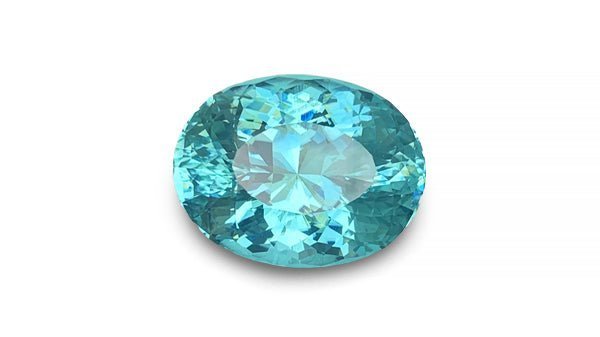
Copper entered tourmaline's recipe in one Brazilian hillside, discovered in the late 1980s, and produced a neon blue-green glow that no other gemstone approaches. Later copper-bearing finds in Mozambique and Nigeria widened the supply without dimming the demand, and fine Paraiba now trades above most rubies and emeralds per carat. The discovery, the naming disputes, and the market are covered in our dedicated Paraíba tourmaline guide.
8. Padparadscha Sapphire
Padparadscha is rare twice over: the pink-orange corundum itself is uncommon, and the definition that earns the name is a knife edge, with both colors required in balance and a laboratory deciding which side a stone fell on. When one hue dominates, the stone is reclassified as a pink or orange sapphire at a fraction of the price, which makes padparadscha one of the few gems whose rarity is partly administrative. The lotus-colored details are in our padparadscha profile.
Rare Beyond Their Own Fame
9. Tsavorite Garnet
Tsavorite is the quiet entry on this list: a vivid green garnet from Kenya and Tanzania that is scarcer in fine large sizes than emerald, arrives untreated as a market norm, and still trades below the stone it rivals, because it was discovered in 1967 and never accumulated four thousand years of publicity. Clean stones above 3 carats are genuinely scarce, and the full case, including honest price ranges, is made in our tsavorite guide.
10. Taaffeite
In 1945, the Dublin gemologist Richard Taaffe bought a parcel of cut stones sold as spinels and noticed that one of them doubled light, which spinel cannot do. The stone turned out to be a mineral science had never described, making taaffeite the only gemstone in history discovered already faceted. It remains among the rarest gem materials known, sourced in tiny quantities from Sri Lanka and Myanmar, and its even scarcer relative musgravite trades at the outer edge of the collector market. Most jewelers will complete a career without handling either, which is precisely the point of this entry: the top of the rarity pyramid is quieter than any advertisement.
What Rarity Means for a Collector
Three practical rules run through all ten stones. First, rarity prices the top of each category, never the bottom: a weak benitoite or a grayish grandidierite is a mineral specimen, and only fine color, clarity, and cutting turn scarcity into value. Second, identity and treatment need paper in exact proportion to the price, because rare gems attract imitations and mislabeling the way any concentrated value does; what a report confirms and where its limits lie is covered in why certification matters. And third, origin claims follow the same rule here as everywhere, they belong on laboratory reports rather than in listings, as explained in our guide to gemstone origins and rarity.
Durability sorts the list for jewelry use: alexandrite, tsavorite, and sapphire wear daily without worry, tanzanite and tourmaline ask for sensible care, and black opal, red beryl, and the ultra-rarities belong in protective settings or in the collection case, with the family-wide rules covered in our gemstone care guide. As always, a stone's individual quality and documentation decide its worth; the rarity of its species only sets the stage.
Frequently Asked Questions
What is the rarest gemstone in the world?
Among stones a collector can realistically encounter, taaffeite and its relative musgravite sit at the top, alongside red beryl and benitoite. Each is rarer than diamond by orders of magnitude, and faceted examples above a carat are museum-grade events.
Is tanzanite really rarer than diamond?
As a species, yes, dramatically: tanzanite comes from a single deposit of a few square kilometers in Tanzania, while diamonds are mined on every continent except Antarctica and Europe. Individual stone values still depend on color, clarity, size, and documentation.
Why is red beryl so rare?
It requires beryllium and manganese to meet under conditions found in gem quality essentially only in Utah's Wah Wah Mountains. By a frequently cited estimate, one red beryl forms for roughly every 150,000 diamonds, and most crystals are too small to facet.
What gemstone was discovered already cut?
Taaffeite. In 1945 Richard Taaffe noticed that one stone in a parcel of cut spinels doubled light, which spinel cannot do, and it proved to be a previously unknown mineral, the only gem ever discovered in faceted form.
Are untreated rare gemstones more valuable?
Generally yes. Several stones on this list, including tsavorite, benitoite, and taaffeite, are untreated as a norm, which collectors prize. Any treatment must be disclosed, and a laboratory report is the reliable statement of a stone's status.
Which rare gemstones suit daily wear?
Alexandrite, tsavorite, and padparadscha sapphire handle everyday jewelry well. Tanzanite and Paraiba tourmaline wear comfortably with sensible care, while black opal and red beryl deserve protective settings or occasional wear.
Do rare gemstones always cost more than classic gems?
No. Rarity and price meet only where demand exists: fine Paraiba and red beryl exceed most rubies per carat, while single-source ametrine remains affordable because its market is small. Supply, demand, and quality set the price together.
How should a beginner start collecting rare gemstones?
Start with documented stones from the accessible end of the list, tsavorite or tanzanite, insist on laboratory reports naming the laboratory, and buy the best color and clarity the budget allows rather than the largest stone. Quality within a species always outranks the species' name.